When you first start a blog, choosing your niche can feel like a decision you need to get absolutely right. You spend time researching ideas, considering your interests and trying to find a subject with enough potential to build a successful website. But what happens if you change your mind?
Perhaps you’ve lost interest in your original topic, discovered a subject you’d rather write about, or realised that your current blog isn’t heading in the direction you’d hoped.
Does that mean you’ve made a mistake? Do you need to start again with a completely new website? And what happens to all the content you’ve already published?
The good news is that you can change your blog niche later. Your original choice doesn’t have to determine what you write about forever. However, the best way to approach a change depends on how different your new direction is and how much you’ve already built.
In this guide, we’ll explore when changing your niche makes sense, how to decide whether you need a completely new direction or simply a more focused approach, and what to consider before making the transition.
Can You Really Change Your Blog Niche?
Yes! There’s no rule that says you must stick with the niche you originally chose when you started your blog.
Perhaps you’ve discovered new interests, developed knowledge in another area or realised that the subject you initially chose isn’t something you want to build a website around long term.
It’s also possible that your blog has gradually developed in a direction you didn’t originally anticipate.
For example, imagine you started a blog about general home and lifestyle topics. Over time, you find yourself writing more about sustainable living, reducing household waste and making environmentally conscious choices.
You might discover that these subjects are where your interests and content ideas naturally overlap. Rather than continuing to publish a mixture of unrelated lifestyle articles, you could decide to reposition your blog around sustainable living.
That’s a change in direction, but it doesn’t necessarily mean throwing away everything you’ve already created.

Even if you decide to move into a completely different subject, you may still be able to adapt your existing website. The amount of work involved will depend on how closely the new niche relates to your original one and whether your current domain, content and audience are still relevant.
Your blog isn’t necessarily tied to the idea you started with. What matters is choosing a new direction that makes sense for the website you want to build.
Refining Your Niche vs Changing It Completely
Before deciding whether you need a new niche, it’s worth understanding the difference between refining your existing focus and changing direction altogether.
These aren’t necessarily the same thing, and the amount of work involved can be very different. Here are three examples:
|
Type of change |
Example |
What it involves |
|---|---|---|
|
Narrowing your niche |
A general gardening blog becomes a vegetable gardening blog |
Concentrating on a more specific subject and audience |
|
Refining your niche |
A travel blog becomes a budget travel blog for families |
Keeping the main subject but changing the audience or approach |
|
Changing your niche |
A baking blog becomes a personal finance blog |
Moving into a substantially different subject area |
The first two examples are often about giving an existing blog a clearer identity rather than moving into an entirely new subject.
Perhaps you’ve covered too many topics, attracted an unclear audience or struggled to establish a consistent direction. In that situation, you may not need a new niche at all. You might simply need to narrow your focus, adjust your approach and reorganise your existing content.
A complete niche change, however, is different. If your original subject no longer interests you and you want to build your blog around something substantially unrelated, you’ll need to consider whether your existing website is still the right foundation.
Understanding which situation you’re dealing with is the first step towards making the right decision.
How Do You Know If It’s Time to Change Your Blog Niche?
Just because you’re feeling uncertain about your blog doesn’t automatically mean you need to change your niche.
It’s normal to have periods when you struggle to come up with ideas, lose motivation or wonder whether you’re heading in the right direction.

These feelings don’t necessarily mean you’ve chosen the wrong subject. However, there are some signs that your original niche may no longer be the right fit.
1. You’ve Genuinely Lost Interest in Your Subject
One of the biggest reasons bloggers consider changing their niche is that they no longer enjoy writing about it.
Perhaps you were enthusiastic when you started, but after publishing dozens of articles, you’re finding it increasingly difficult to come up with new ideas or feel motivated to create content.
If you consistently find yourself forcing articles out or avoiding the subject altogether, it’s worth asking whether you still want to build a website around it.
You don’t have to love every article you publish, but building a blog around a subject you no longer care about can make it difficult to stay motivated over the long term.
2. Your Interests or Expertise Have Developed in Another Direction
Sometimes, your interests change or you develop knowledge and experience in a subject you’d much rather explore.
For example, you might have started a general fitness blog but, over time, developed a particular interest in strength training for women over 40. Perhaps you’ve taken courses, gained practical experience or simply discovered that this is the subject you’re most enthusiastic about.
If your interests and knowledge have developed naturally in another direction, it may be worth considering whether your blog should evolve with them.
3. Your Blog Has Evolved Beyond Its Original Concept
Sometimes, it’s not your personal interests that change. Instead, creating content helps you discover what your blog could become.
Perhaps you started a general food blog but found that your most useful and well-received articles were about meal planning for busy households. Over time, you may realise that this is a more focused direction with greater potential than the broader subject you originally planned to cover.
Your experience creating content can reveal opportunities you hadn’t considered when you first started. This doesn’t necessarily mean abandoning your original niche. It may simply be a sign that your blog would benefit from a clearer direction.
4. Your Original Niche No Longer Fits Your Goals or Plans
Your reasons for starting a blog may also change over time. Perhaps you initially wanted a small hobby blog, but you’ve since decided to build a more substantial online business.
Or maybe your original content direction no longer aligns with the products, services or other income streams you’d like to develop.
You may also have reached a point where you struggle to see how your original concept can develop into the kind of website you want to build.
Your niche should give you room to create useful content, explore new ideas and work towards your longer-term goals. If your current direction feels increasingly restrictive, it may be time to reconsider whether a different focus would serve you better.
Don’t Confuse a Traffic Problem With a Niche Problem
Poor traffic or disappointing earnings alone aren’t necessarily reasons to change your niche. Your blog may be struggling because of content quality, search visibility, website structure or an unclear monetisation strategy and changing the subject won’t automatically fix those problems.
Before making a major decision, try to identify what’s actually holding your blog back. You may discover that it needs a better strategy or a more focused approach rather than a completely new niche.
Should You Change Your Blog Niche or Start a New Blog?
If you’ve decided that your original niche is no longer right for you, the next question is whether you should adapt your existing website or start a completely new one.
There’s no universal answer. It depends on how closely your new subject relates to the old one, what you’ve already built and whether your existing website can provide a suitable foundation for the change.
When It Makes Sense to Keep Your Existing Blog
Keeping your current website may be the better option if:
- Your new subject is closely related to the original one. You can build on existing content and knowledge rather than starting from scratch.
- There’s some audience overlap. Your existing readers are likely to have an interest in the new direction.
- Some of your existing content is still relevant. You already have useful articles that can remain part of the website.
- Your domain name and branding are still suitable. The existing name doesn’t restrict you to a subject you’re moving away from.
- You’ve built an established website. You have content, an audience, relevant backlinks or other assets that may support the new direction.
For example, if you started a general gardening blog and want to focus specifically on growing vegetables, keeping the existing website would probably make more sense than creating an entirely new one.
You can gradually refine your content, update your website structure and make the new focus clearer to readers.
When Starting a New Blog Might Be Better
In other situations, a separate website may be the more sensible choice.
Consider starting a new blog if:
- Your new subject is completely unrelated. Moving from a baking blog to personal finance, for example, would represent a substantial change in topic and audience.
- Your existing readers are unlikely to be interested. There’s little connection between what they originally followed you for and what you now want to publish.
- Your domain name is strongly tied to the old niche. A name that specifically references baking, for instance, may not make sense for a finance website.
- Most of your existing content won’t support the new direction. You may have very little that can be retained or adapted.
- You want to build a separate brand. You may prefer to keep your original blog intact rather than turn it into something entirely different.
Starting a new website means building your content, audience and brand from the beginning, so it’s worth weighing that effort against the work involved in adapting your existing blog.
If you’re still unsure which option makes more sense, consider the following four questions in the graphic below. They can help you weigh up whether your existing website is a suitable foundation for your new direction.
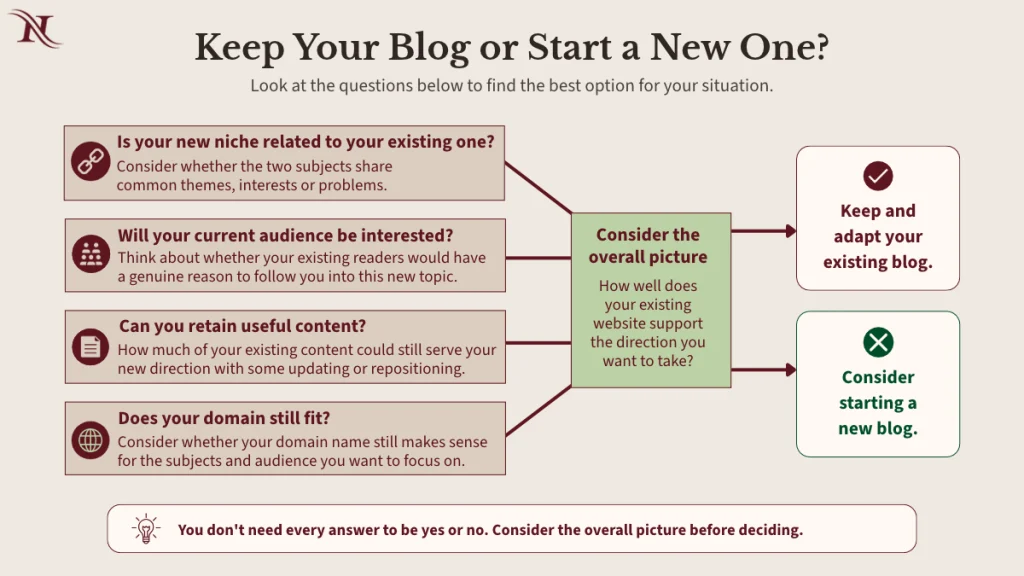
Also, don’t assume that an older domain is automatically the better option simply because it’s been around longer. Relevant content, an existing audience and useful backlinks may give your current website value, but only if they provide a suitable foundation for the new subject.
If you’re considering a completely new blog, take the time to validate your new niche idea before committing to it. You don’t want to go through the same uncertainty again a few months down the line.
What Happens to Your Existing Blog Content?
One of the biggest concerns when changing a blog niche is what to do with all the articles you’ve already published.
If you’ve spent months or even years building your content library, the thought of removing large portions of it can be daunting.
The good news is that you don’t necessarily have to delete everything that doesn’t fit perfectly into your new direction.
Instead, review your existing articles and decide which should be kept, updated, combined or removed.
Pro Tip: Look for Opportunities Before Removing Content
An article doesn’t necessarily have to match your new niche perfectly to remain useful. Consider whether it could be updated, repositioned or incorporated into a broader resource before deciding to remove it. The aim is to retain content that still offers value, not to make every existing post fit your new direction.
Keep Content That’s Still Relevant
If an article supports your new niche and remains useful to your intended audience, there’s no reason to remove it simply because you’re changing direction.
Some topics naturally overlap with your new focus, and existing articles may continue to provide useful information for the readers you’re now trying to reach.
Preserve content that still serves a purpose. Before removing an article, consider its relevance to your new audience and its existing value.
Update and Reposition Existing Articles
Some articles may still be useful but need a little work to fit your new focus. You might need to update the introduction, adjust examples, refine the content or change internal links so that the article makes more sense within the new direction.
For example, a general article about healthy eating could potentially be repositioned around meal planning for busy families if that becomes your new subject. The important thing is to make sure the revised article genuinely serves the new audience rather than simply changing a few keywords.
When reorganising my own website, I found that changing the overall direction wasn’t simply a matter of updating individual articles.
I also needed to look at how the content fitted together, how visitors moved between related topics and whether the website as a whole communicated a clear purpose. It reinforced how important it is to consider the bigger picture rather than making isolated changes.
Combine Overlapping Content
If your original blog covered several related subjects, you may find that some articles overlap or cover similar information. This can be an opportunity to consolidate them into more comprehensive resources.

For example, you might have several shorter articles covering different aspects of the same subject. Rather than keeping multiple posts that repeat similar information, you could combine them into one stronger, more useful guide.
Before consolidating pages, consider their existing URLs, search visibility and backlinks so you don’t unintentionally lose value from content you’ve already published.
Remove or Redirect Content That No Longer Fits
Some articles may have no meaningful connection to your new niche. If they no longer serve your intended audience and can’t reasonably be updated or incorporated into the new direction, removing them may be appropriate.
However, don’t delete content indiscriminately. Before removing a page, consider whether it serves a purpose for existing readers, attracts visitors or has valuable backlinks.
If you decide to remove it, consider whether there’s a genuinely relevant replacement page to redirect it to. Avoid redirecting unrelated articles simply to send visitors somewhere else, as this can create a confusing experience.
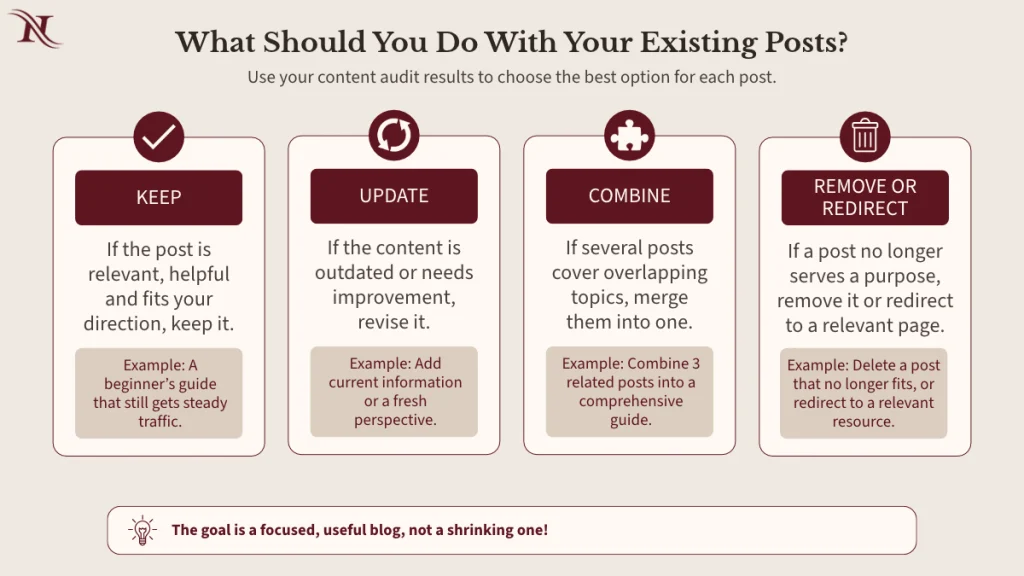
The goal isn’t to make every old article fit your new niche. It’s to create a content library that makes sense for the website you’re building now.
Will Changing Your Blog Niche Affect Your SEO?
Changing your blog niche can affect your search visibility, particularly if your new subject is very different from the one you’ve been covering.
However, changing your niche doesn’t automatically result in a Google penalty or mean you’ll lose all the search visibility you’ve built.
The impact depends on what you’re changing. If you keep your existing URLs and retain content that’s still relevant, the transition may be relatively straightforward. If you substantially rewrite, remove or redirect pages that currently attract visitors, you may see changes in your search performance.
There are a few things worth keeping in mind.
Your Existing Search Traffic May Change
If your blog currently attracts visitors through articles that no longer fit your new direction, you may find that some of those pages gradually lose visibility.
Other articles may continue to perform well because they’re still relevant to your new niche.
This is why it’s important to understand which pages are bringing visitors to your website before making major changes. You don’t want to remove or substantially alter valuable content without first considering what it contributes to your site.
Your Internal Links and Website Structure May Need Updating
Your internal links help readers discover related content and understand how different pages on your website connect.
If you’re changing your niche, some existing links may no longer make sense. You may also need to update your categories, navigation and other links so they reflect the subjects you’re now focusing on.
The aim is to create a website structure that makes your new direction clear and helps visitors find relevant information.
Your Website May Need Time to Establish Its New Focus
If you’re moving into a substantially different subject, don’t expect your search performance to change overnight.
You’ll need to publish useful, relevant content for your new audience and build a consistent collection of articles around your chosen topics.
Search engines will need to recrawl and reassess pages as your website evolves. Significant changes can result in temporary ranking fluctuations, and there’s no guaranteed timeframe for your visibility to settle.
It’s also worth remembering that publishing more articles won’t automatically restore traffic you’ve lost. Your new content needs to be genuinely useful, relevant and capable of meeting the needs of your intended audience.
How to Protect Your SEO During a Niche Change
Before making significant changes, take a little time to review your website’s existing search performance and plan what needs to be updated.
Here are some sensible precautions:
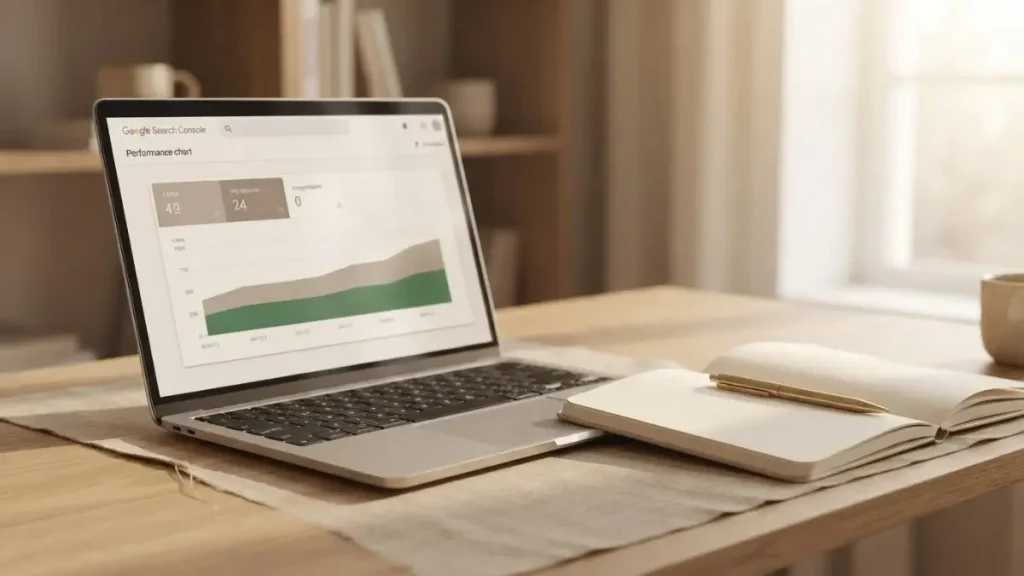
- Check Google Search Console. Review which pages receive organic clicks and impressions, and identify any articles that are particularly important to your existing traffic.
- Update your internal links. Make sure links between articles reflect your new content focus and help readers discover relevant information.
- Review your categories and navigation. Your website structure should make your new direction clear and help visitors find the content they’re looking for.
- Use redirects carefully. If you remove a page or change its URL, redirect it to a genuinely relevant replacement where one exists. Avoid sending unrelated pages to your homepage or loosely connected articles.
- Monitor your performance. Keep an eye on Google Search Console after making changes. Compare clicks, impressions and indexing information so you can identify significant changes and investigate where necessary.
If you’re changing URLs as part of a wider website restructure or domain move, Google’s guidance on site moves and URL changes is worth reading before you begin.
Changing your niche doesn’t automatically mean losing your existing search visibility. The key is to make considered changes, understand what you’re potentially giving up and give your website a clear direction going forward.
What About Your Existing Audience?
If you’ve already built an audience around your original niche, it’s natural to wonder how they’ll react when you start publishing different content.
Some readers may be happy to follow you in a new direction, particularly if your new subject is closely related to what they originally came for. Others may have little interest in the change.
That’s perfectly normal. You can’t assume that everyone who enjoyed your original content will be interested in your new focus.
Be Clear About the Change
If you’re making a significant change, it’s a good idea to let your existing readers know what’s happening.
You don’t need to write a lengthy explanation or justify your decision, but a short announcement can help avoid confusion when visitors start seeing different topics on your website.
You could explain:
- Why you’ve decided to change direction.
- What subjects you’ll be focusing on from now on.
- Whether your existing content will remain available.
- What readers can expect from the website in future.
If you have an email list, consider sending a short update to your subscribers. You could also publish an announcement on your blog or share the news through your social media channels.
The aim is simply to be transparent and help existing readers understand what to expect.
Consider Whether a Gradual Transition Makes Sense
If your new niche is closely related to your original subject, you may be able to introduce the change gradually. For example, you could begin publishing more articles around your new focus while gradually reducing content that no longer fits.
This gives existing readers an opportunity to discover your new direction without making the change feel completely unexpected.
However, if you’re moving into an entirely unrelated subject, a gradual transition may not be particularly useful. In that situation, it’s often clearer to explain the change and establish your new focus.
Don’t Feel Obliged to Keep Everyone
It’s worth remembering that your existing audience isn’t necessarily the audience you want to attract in the future.
Some readers may unsubscribe, stop visiting or simply lose interest. While that’s not ideal, it doesn’t mean you’ve made the wrong decision.
If you’re changing your niche because you want to build a website around a subject you’re more interested in, it makes sense to focus on attracting readers who are genuinely interested in that subject.
Your goal isn’t to keep every existing reader. It’s to build an audience that connects with the direction your blog is heading.
Do You Need to Change Your Blog Name, Domain or Branding?
Changing your blog niche doesn’t automatically mean you need a new blog name, domain or visual identity.
In some cases, your existing website may still be perfectly suitable for your new direction. In others, your name or branding may be so closely associated with your original subject that making a few changes would help avoid confusion.
The important thing is to consider whether your current identity still reflects the website you’re building.
Does Your Blog Name Still Fit?
Start by looking at your blog name. If it’s broad enough to accommodate your new subject, there’s probably no reason to change it. A name that isn’t tied to a particular topic can give you plenty of flexibility as your website develops.
However, if your name specifically references your original niche, it may feel out of place when you start publishing content about something completely different.
For example, a blog called The Baking Corner might create confusion if you decide to move into personal finance.

You could keep the name if you have a strong reason to do so, but consider whether a different name would make your website’s purpose clearer to visitors.
Do You Need a New Domain Name?
Your domain name deserves similar consideration, but remember that changing your blog name doesn’t necessarily mean you have to change your domain.
If your existing domain still works for your new direction, you can usually keep it. You don’t need to register a new one simply because your content focus has changed.
However, if your domain is strongly tied to your old niche, you may decide that a different one would be more appropriate.
Changing Your Domain Is a Bigger Decision
Changing your domain is a much bigger undertaking than updating your blog name or logo. You’ll need to move your website to a new address, implement appropriate redirects and check that important technical elements are correctly configured. It can also affect your search visibility while search engines process the move. If your existing domain can still accommodate your new direction, keeping it may save you considerable work.
Does Your Branding Need an Update?
Even if you keep your blog name and domain, your visual branding may benefit from a refresh.
Consider whether your existing logo, colours, imagery and overall website design still reflect the subjects you’re now covering.
You may only need a few small adjustments rather than a complete redesign. For example, changing your imagery or updating your colour palette might be enough to give your website a look that better suits its new direction.
There’s no need to replace every design element if your existing branding still works.
Update Your Website Messaging
Finally, make sure the information visitors see when they arrive at your website accurately reflects its new direction.
This might involve updating:
- Your homepage introduction: Explain what your website covers and who it’s intended to help.
- Your About page: Make sure your description of the blog reflects its current purpose.
- Your tagline: If you use one, check that it still communicates the right message.
- Your navigation: Help visitors find the subjects and resources that are now central to your website.
These changes don’t have to happen all at once, but they should work together to give visitors a clear understanding of what your blog is about.
You don’t need to change everything to make a fresh start. Keep the parts of your existing identity that still work, and update anything that no longer represents the direction you’re taking.
How to Change Your Blog Niche Without Creating More Problems
Once you’ve decided that changing your blog niche is the right move, it’s worth taking a little time to plan the transition.
Making changes without a clear direction can leave your website feeling disjointed, confuse existing readers and create unnecessary SEO problems.
You don’t have to get everything perfect before you begin, but having a plan will make the process much easier to manage.

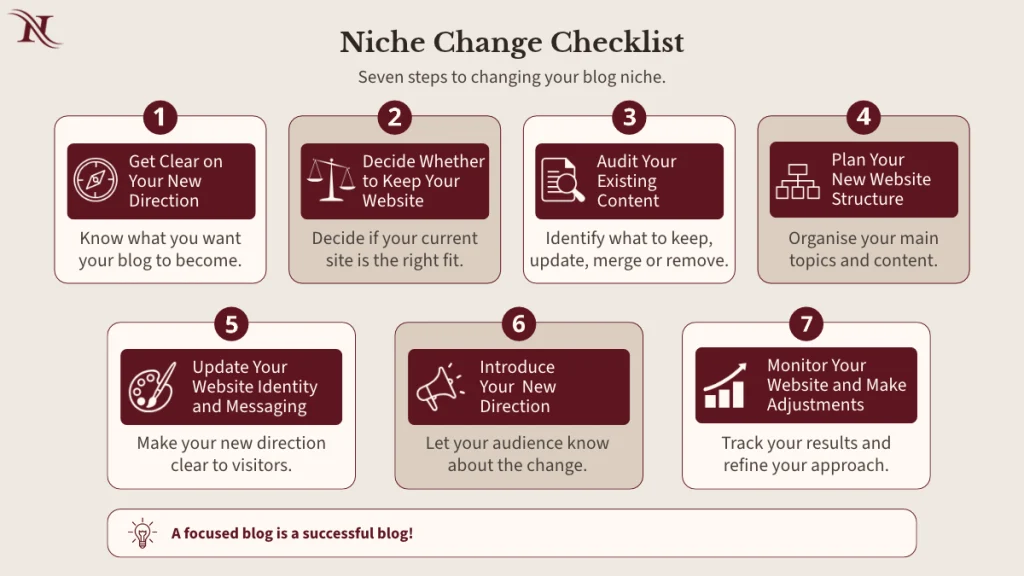
Here are seven steps to help you make the transition.
1. Get Clear on Your New Direction
Before changing anything on your website, make sure you know what you want your blog to become.
Think about:
- The main subject you want to focus on.
- The audience you want to attract.
- The problems or questions your content will help them with.
- The topics you want to cover regularly.
- How you eventually want to monetise your website.
You don’t need a complete content plan at this stage, but you should have a clear enough idea of your new direction to make consistent decisions.
If you’re still unsure whether your new idea has enough potential, revisit the process of choosing and validating a blog niche before committing to the change.
2. Decide Whether to Keep Your Existing Website
Before investing time in making changes, decide whether your current website is the right foundation for your new direction.
Consider how closely the new subject relates to your original niche, whether your existing content and audience are still relevant, and whether your domain and branding can accommodate the change.
If you’ve decided that starting a separate blog makes more sense, you can begin planning that project instead of trying to make an unsuitable website fit.
3. Audit Your Existing Content
Take stock of everything you’ve already published before making significant changes.
Identify which articles can remain as they are, which need updating, which could be combined and which no longer serve a useful purpose.
It’s also worth checking which pages attract search traffic or have valuable backlinks before deciding to remove or redirect them.
You don’t need to make every decision immediately. The aim is to understand what you’re working with and prioritise the changes that matter most.
4. Plan Your New Website Structure
Think about how your new content will be organised.
Consider the main topics you want to cover, how they’ll fit into your website’s categories and how visitors will navigate between related articles.
If you’re moving into a more focused niche, this is an opportunity to create a clearer structure that makes your website easier to understand and explore.
You don’t need dozens of categories or a complicated navigation system. Start with the main subjects your blog will cover and build from there.
5. Update Your Website Identity and Messaging
Once your new direction is clear, make any necessary changes to your blog name, branding, homepage and About page.
You want visitors to understand what your website is about, who it’s for and what they can expect to find there.
Remember, you don’t necessarily need a complete rebrand. Focus on the changes that will make your new direction clearer and ensure your website presents a consistent message.
6. Introduce Your New Direction
If you already have readers or email subscribers, let them know about the change.
Explain what you’re focusing on, why you’ve decided to move in this direction and what they can expect from your website in future.
You can also introduce your new content through your usual social media channels.
As you make the transition, start publishing useful articles that support your new niche. Building a relevant collection of content will help establish your new focus and give visitors a reason to explore your website.
The aim is to make the transition clear rather than leaving existing readers wondering why your website suddenly looks or feels different.
7. Monitor Your Website and Make Adjustments
Once you’ve started making changes, keep an eye on how your website is performing.
Use Google Search Console to monitor organic clicks, impressions and indexing, and pay attention to the content and topics that are attracting visitors.
You should also consider how readers are responding to your new direction. Are they finding the information they’re looking for? Are your new articles attracting the audience you want to reach?
Don’t expect everything to fall into place immediately. Building a clear identity around a new subject takes time, and you may need to adjust your approach as you learn what works.
The important thing is to keep your content, website structure and overall direction working towards the same goal.
Let’s Get Your Blog Heading in the Right Direction
Choosing a blog niche is an important decision, but it doesn’t mean you’re committed to writing about the same subject forever.
Your interests can change, your knowledge can develop and your goals may look very different from when you first started your website. Sometimes, changing direction is simply part of figuring out what you really want to build.
The important thing is to understand what kind of change your blog actually needs.
You might discover that your original niche is still right for you, but your website needs a more focused approach. Or you may decide that a completely different subject is a better fit for your interests and long-term plans.
Either way, take the time to consider your existing content, audience, website identity and search visibility before making significant changes.
And remember, you don’t have to rush the process. A little planning now can save you a lot of unnecessary work later.
Your blog doesn’t have to stay the same forever. Just make sure your next direction is one you’re genuinely happy to build around.
I’d Love to Hear From You!
Are you considering changing your blog niche, or have you already made the switch? Perhaps you’ve discovered a new interest, outgrown your original subject or realised your blog needs a different direction.
Drop a comment below and tell me what’s prompted your decision. I’d love to hear about your experience and help you think through any questions or concerns you might have.
Happy Blogging!

NEXT STEP
Does Your New Niche Have Potential?
If you’re considering a change, it’s worth making sure your next niche has genuine potential. My step-by-step guide on How to Choose a Niche for a Blog will help you explore your interests, assess demand and identify opportunities to build a blog around.
Helpful Guides to Read Next
These beginner-friendly guides will help you keep building your blog step by step.

Jessie
Founder, nomorerush.com
Hi, I’m Jessie — founder of No More Rush. I help beginners build profitable, beginner-friendly blogs without the overwhelm or unrealistic expectations you see online. Everything here is built around simple, structured steps so you always know what to do next.