You’ve found a blog niche that interests you, and perhaps you’ve already started researching whether people are searching for it. But before you commit months of work to building a blog, there’s one more important question to ask: does your niche have realistic earning potential?
A topic can attract plenty of interest without necessarily offering obvious ways to generate revenue. That’s why it’s worth investigating the commercial side of your niche before you invest too much time and effort.
In this guide, I’ll show you how to look for evidence of relevant products, services, businesses and buying interest. We’ll also explore whether your niche has the potential to support display advertising or useful digital products, helping you build a clearer picture of its commercial opportunities.
If you haven’t yet checked whether people are searching for your topic, whether there’s room for a new blog, and whether you have enough content opportunities, start with my guide to How to Validate a Blog Niche Before You Commit. Once you’ve completed that research, you can return here to investigate its commercial potential.
If you’re still working through the process of choosing a niche, my guide to How to Choose a Niche for a Blog walks you through the bigger picture, from finding a suitable topic to assessing its long-term potential.
1. What Commercial Evidence Are You Looking For?
When assessing whether a blog niche could make money, you’re not trying to predict exactly how much you might earn. You’re looking for evidence that there’s an existing commercial market connected to the people, interests and problems your blog would serve.
In other words, are there products, services or other paid solutions that genuinely make sense for this audience?
Think about the needs of someone interested in your chosen topic. They might need specialist equipment, want to compare different products, be looking for software to make a task easier, or need help solving a particular problem. These needs can point towards potential commercial opportunities.
What That Evidence Looks Like
For example, someone interested in photography might eventually want to buy a camera, compare lenses, invest in editing software or pay for a course to improve their skills. Someone interested in gardening might need tools, seeds, raised beds, garden-planning resources or professional advice.
These examples don’t prove that either niche will be profitable. They simply illustrate how an audience’s interests and needs can connect to products and services that already exist.
As you investigate your own niche, look for four broad types of evidence:
- Relevant products and services: Are there things people in this niche regularly need, use or pay for?
- Established businesses: Are companies already serving this audience with products, services, software, subscriptions or other paid solutions?
- Buying and comparison activity: Are people searching for reviews, recommendations, alternatives and comparisons when deciding what to buy?
- Problems that could support useful digital resources: Are there recurring challenges that might create opportunities for useful digital products, such as templates, planners or workbooks?
You won’t necessarily find equally strong evidence in all four areas, and that’s fine. Different niches have different commercial characteristics. The aim is to understand the opportunities that exist within your particular subject rather than force it to fit a predetermined business model.
It’s also worth remembering that you don’t need to find a ready-made product for every article you might eventually publish. The important thing is to establish whether there are credible commercial opportunities within the niche as a whole.
With that in mind, let’s start by looking at the products and services already available to your potential audience.
2. Search for Products That Solve Real Problems
One of the easiest ways to begin investigating a niche’s commercial potential is to look at the products people already use to support their interests, solve problems or achieve particular goals.
Start by thinking about what someone interested in your niche might need. Depending on the subject, this could include physical products, specialist equipment, software, subscriptions, educational resources or everyday supplies.

For example, if you’re researching a photography niche, you might look for:
- Cameras and lenses.
- Lighting and photography accessories.
- Photo editing software.
- Camera bags and storage equipment.
- Online photography courses and learning resources.
For a gardening niche, you might investigate:
- Gardening tools and equipment.
- Seeds, plants and growing supplies.
- Raised beds and irrigation systems.
- Greenhouses and protective equipment.
- Garden planning resources.
These are just starting points. The aim isn’t to create a huge shopping list, but to discover whether there are relevant products and services that naturally connect to the audience you’re hoping to reach.
Where to Find Relevant Products
You don’t need specialist tools to begin this research. A few straightforward searches can reveal quite a lot. Try searching Google using combinations of your niche topic and terms such as:
- Best [product] for [specific need]
- [Niche] tools and equipment
- [Niche] supplies
- [Niche] software
- [Niche] courses
- [Product] for beginners
For example, someone researching a home DIY niche might search for “best power tools for beginners”, “essential DIY tools” or “woodworking software”.
You can also browse relevant online retailers, specialist stores and manufacturers’ websites. Look at the range of products they offer, the problems those products address and whether there are options for different budgets or levels of experience. As you research, pay attention to the following:
- Relevance: Do these products genuinely relate to the interests and problems of your intended audience?
- Variety: Are there several types of products, tools or resources, or does the opportunity seem limited to one or two items?
- Different needs: Are there products for beginners as well as more experienced people?
- Practical value: Do these products help people achieve something, solve a problem or make a task easier?
- Alternatives: Are there several competing products or solutions, giving readers a genuine choice?
A wide selection of relevant products can be an encouraging sign, particularly when they address different needs within the same niche.
However, don’t mistake the number of products available for proof of profitability. A large catalogue doesn’t necessarily mean people are actively buying those products, and not every product will be suitable for a blog recommendation.
What matters is whether you can identify a genuine connection between the products available and the needs of the people your blog would serve.
3. Look for Businesses Already Serving Your Audience
Another useful way to investigate a niche is to look at the businesses already operating within it.
If companies are investing in products, services and resources for a particular audience, that can provide evidence of an existing commercial market. It also helps you understand the different ways people in that niche are currently spending money.
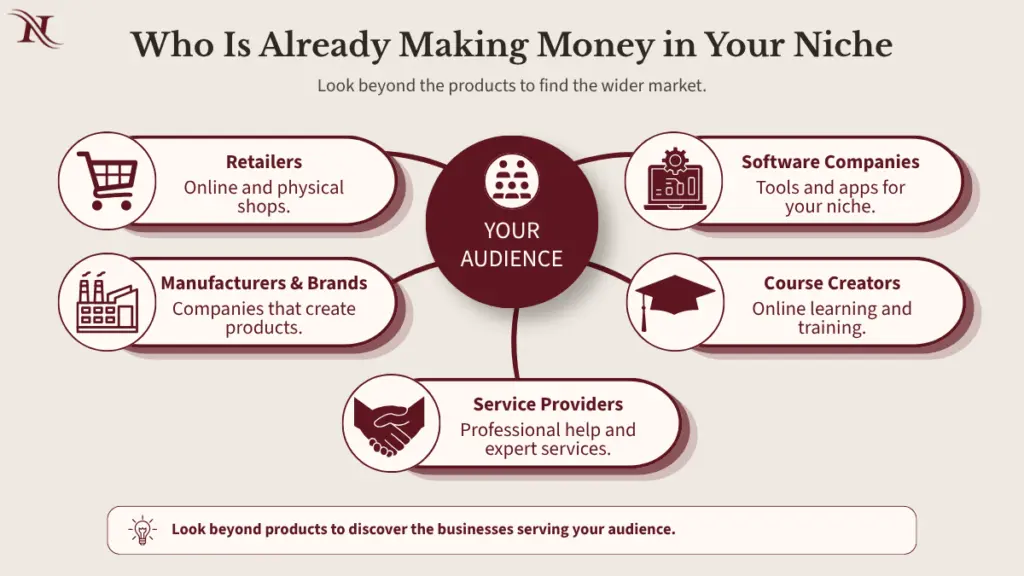
Start by looking beyond individual products and consider the businesses behind them. Depending on your niche, these might include:
- Specialist retailers and online stores.
- Manufacturers and established product brands.
- Software companies and subscription services.
- Course creators and educational platforms.
- Professional service providers.
- Membership organisations and specialist communities.
For example, a photography niche might have camera retailers, editing software companies, online photography schools and businesses offering professional printing services.
A pet-related niche might have specialist food brands, grooming product companies, pet insurance providers, training services and subscription businesses.
What Should You Look For?
As you explore these businesses, try to establish whether there’s a reasonably varied market serving your intended audience. Ask yourself:
- Are several businesses offering relevant products or services?
- Do they cater to different budgets or levels of experience?
- Are there established brands as well as smaller specialist businesses?
- Do they address different needs within the niche?
- Are there paid solutions beyond the obvious physical products?
For instance, if you’re researching a home DIY niche, finding a handful of tool retailers is useful, but discovering businesses offering design software, specialist workshops, project-planning resources and professional services gives you a broader picture of the market.
You don’t need to investigate every company in detail. A small collection of relevant examples is enough to start identifying the types of commercial activity taking place. It’s also worth looking at whether the market appears to depend heavily on one company or product.
If most of the obvious opportunities revolve around a single brand, that may leave you with fewer alternatives and make the niche more dependent on that particular business than a market where several companies serve the same audience.
Remember: Established businesses are evidence that commercial activity exists within a niche, not proof that a new blog will automatically benefit from it. You’re looking for potential opportunities to investigate further, rather than trying to estimate what those businesses earn or how much you could make.
4. Check Whether People Are Already Comparing Products
Finding relevant products and businesses is a good start, but there’s another useful question to investigate:
Are people actively looking for information to help them decide what to buy?
This is where Google searches can reveal additional clues about the commercial potential of your niche.
Think about the difference between someone searching for “how to improve indoor lighting” and someone searching for “best photography lighting kit for beginners”.

Both searches relate to photography, but the second suggests that the person may already be considering a purchase and comparing available options.
You can look for this type of activity by combining your niche topic or relevant products with phrases such as:
|
Search phrase |
What it may indicate |
|---|---|
|
Best [product] for [need] |
Someone researching suitable options. |
|
[Product A] vs [Product B] |
Someone comparing alternatives. |
|
[Product] review |
Someone looking for more information before deciding. |
|
Is [product] worth it? |
Someone evaluating its value. |
|
Alternatives to [product] |
Someone exploring other available options. |
For example, if you’re considering a gardening blog, you could search for phrases such as:
- Best raised garden beds for small spaces.
- Wooden vs metal raised garden beds.
- Raised garden bed reviews.
- Are self-watering planters worth it?
- Alternatives to expensive garden irrigation systems.
These searches can help you discover whether people are looking for guidance when choosing between products or deciding whether a particular purchase is worthwhile.
How to Investigate These Searches
Start with Google and enter a few of the phrases relevant to your niche. Look at the suggestions that appear as you type, as well as the actual search results. Pay attention to:
- Whether there are genuine product comparisons and reviews.
- Whether specialist blogs and websites are answering these questions.
- Whether retailers and manufacturers appear alongside informational content.
- Whether the same products or brands appear across several relevant searches.
- Whether you can identify additional related questions worth investigating.
You might also notice that some products have plenty of comparison content, while others have very little. That doesn’t automatically mean there’s an opportunity to target the less-covered products, but it can help you spot areas worth exploring.
Pro Tip:
Don’t judge a niche by one or two promising keywords. Look for a broader pattern of searches that suggests people are researching, comparing and making purchasing decisions within your topic. This can give you a better indication of whether there are realistic commercial opportunities to explore.
Keep in mind that seeing comparison articles in Google doesn’t tell you exactly how many people are searching for those products or whether those searches lead to purchases. Nor does it tell you how competitive those search results might be.
You’re looking for clues about the types of decisions people are researching, rather than trying to measure the size of the market at this stage.
Not Every Niche Needs Lots of Buying-Intent Searches
It’s also important not to judge a niche solely on the number of obvious product-related searches you can find.
Some subjects naturally generate more comparisons and reviews than others. In certain niches, people may spend money on products or services without searching for them using obvious phrases such as “best”, “review” or “vs”.
For example, someone might follow a specialist hobby blog for months, learn new skills and eventually purchase equipment or resources recommended by a trusted source. The commercial opportunity may be connected to the wider needs of that audience rather than a large collection of direct buying searches.
So, treat these searches as useful clues rather than a strict requirement. You’re trying to establish whether there are genuine commercial needs within the niche, not prove that every topic has strong purchase-related search demand.
5. Look Beyond Physical Products: Other Commercial Opportunities
Not every monetisation opportunity in a blog niche revolves around recommending physical products or services. Depending on your subject, there may be other ways to generate revenue that aren’t immediately obvious when you start researching the market.
Two areas worth investigating are the potential for display advertising and the possibility of creating useful digital resources for your audience.
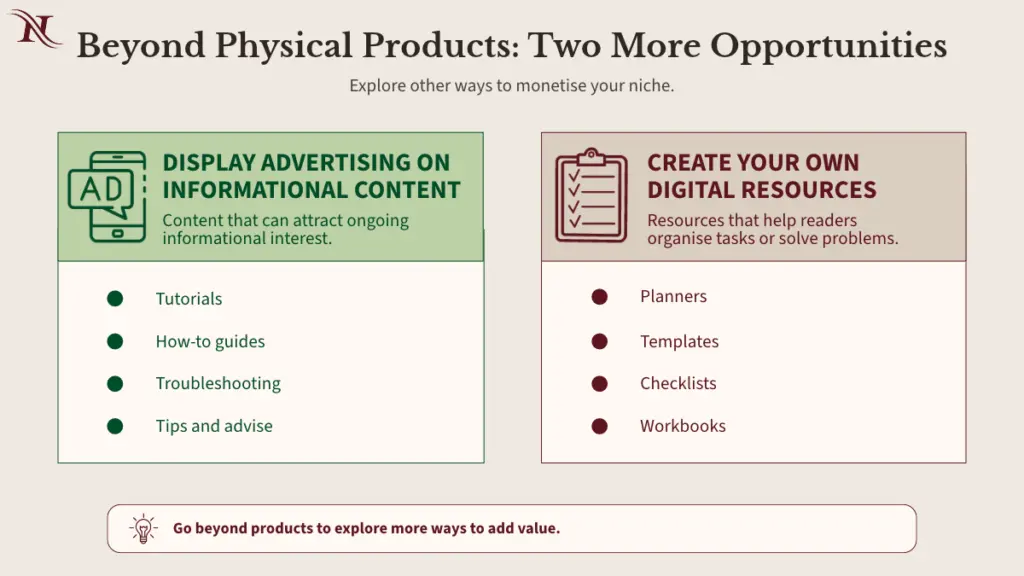
You don’t need to establish exactly how either would work at this stage. Instead, look for evidence that your niche could support these opportunities further down the line.
Could Your Niche Support Display Advertising?
Display advertising is another potential revenue source to consider, particularly in niches where people regularly search for information, advice and solutions to everyday problems.
Unlike affiliate marketing, where income generally depends on readers taking an action such as purchasing a recommended product, display advertising allows a blog to earn revenue by showing advertisements to visitors as they read its content. This means informational articles can create earning opportunities even when readers aren’t looking to buy anything.
For example, a gardening blog could publish useful articles covering topics such as:
- How to prepare soil for planting.
- When to plant different vegetables.
- How to deal with common garden pests.
- How to grow plants in small spaces.
- How to maintain a healthy lawn.
A photography blog might explore camera settings, lighting techniques, composition, editing tips and troubleshooting common photography problems.
When visitors arrive at these articles to find answers or learn something new, advertisements displayed on those pages can potentially generate revenue for the blog. The more useful informational content a site can build, the more opportunities it may have to attract visitors and generate advertising income over time.
As you investigate your niche, consider:
- Topic variety: Can you identify a broad range of useful subjects within the niche?
- Ongoing information needs: Are there questions and problems people are likely to search for regularly?
- Content depth: Could you create detailed, helpful articles without repeatedly covering the same ground?
- Audience interest: Is there enough evidence of people wanting to learn about the subject beyond simply researching products?
If you can identify plenty of useful informational topics, that’s an encouraging sign that your niche could eventually support a content-rich blog.
However, this doesn’t guarantee advertising income. Actual earnings depend on factors such as the traffic your site attracts, audience location, advertiser demand and the suitability of your content for advertising networks. Those are things you’ll only be able to assess more accurately as your blog develops.
For now, you’re simply looking for evidence that your niche has the breadth to support more than commercial content.
Could Your Audience Benefit From Digital Products?
Another opportunity worth considering is whether your niche contains problems or recurring tasks that could be addressed with a useful digital resource.
Think about the things people in your chosen niche regularly struggle with, want to organise or need help completing. Could a template, planner, checklist, workbook or other resource make the process easier? For example:
- Gardening: Seasonal planting calendars, garden planners or vegetable-growing trackers.
- Photography: Editing presets, photography checklists or workflow templates.
- Cooking: Meal planners, recipe collections or kitchen organisation printables.
- Home DIY: Project planners, measurement worksheets or renovation budget templates.
- Blogging: Content planners, niche research worksheets or blog launch checklists.
These are examples of possible solutions, not proof that people would necessarily pay for them. To investigate further, look for:
- Recurring problems: Are there tasks or challenges that people regularly need help with?
- Time-consuming processes: Are there things your audience might appreciate having organised or simplified?
- Existing resources: Are other businesses or creators already offering paid templates, guides, planners or courses?
- Potential gaps: Are there particular needs that existing resources don’t appear to address particularly well?
Look to Online Communities for Recurring Questions
You can also look at the questions people ask in online communities, such as Reddit and relevant discussion groups. Pay attention to repeated frustrations, requests for recommendations and situations where people seem to need more structured guidance.
The existence of similar paid resources can be a useful indication that someone has identified a potential market. However, it doesn’t automatically mean there’s room for another product or that your particular audience would buy one.
At this stage, you’re simply looking for problems that might justify a useful resource in the future.
For example, seeing several people repeatedly ask how to organise a particular task is a useful clue. If you also find existing paid resources addressing that task, you have two different pieces of evidence pointing towards a possible need.
Remember: You don’t need to have a digital product idea before starting your blog. The purpose of this research is to recognise whether your niche contains needs and challenges that could potentially support one as your understanding of the audience develops. Here’s how that research might look in practice.
Example: Assessing the Commercial Potential of a Gardening Blog
Let’s imagine you’ve decided to start a blog about gardening, with a particular focus on helping beginners grow their own vegetables in small spaces. As you research the niche, you begin to uncover several encouraging signs:
- Products and services: You find plenty of relevant products, including raised garden beds, containers, seeds, gardening tools, irrigation systems and growing supplies.
- Businesses serving the audience: There are specialist gardening retailers, seed suppliers, equipment manufacturers and businesses offering garden-planning resources.
- Buying and comparison activity: People are searching for the best raised beds for small gardens, comparing different types of planters and looking for reviews of beginner-friendly gardening equipment.
- Informational content: There are plenty of questions around preparing soil, choosing vegetables, planting schedules, watering, pest control and growing food in limited spaces.
- Potential digital resources: You notice recurring questions about organising planting schedules and planning small vegetable gardens. This could point towards a future opportunity for a planting calendar or garden planner.
Taken together, these findings suggest that the niche has several different types of commercial activity, alongside plenty of opportunities to create useful informational content.
That doesn’t mean a new gardening blog is guaranteed to make money, or that every opportunity will be suitable for your particular audience. However, you’ve found enough evidence to suggest that the niche is worth exploring further.
That’s what you’re looking for at this stage: a credible combination of audience needs, existing commercial activity and opportunities to provide genuine value.
6. Use a Simple Commercial Potential Worksheet
By now, you should have a better idea of the commercial activity surrounding your chosen niche. You’ve looked at relevant products and services, businesses serving your audience, buying-related searches, and opportunities beyond physical products.
Before drawing any conclusions, take a few minutes to organise what you’ve discovered. The worksheet below will help you separate genuine evidence from possible opportunities that may need further investigation.
You don’t need to find examples for every category, and there’s no need to assign your niche a numerical score. The aim is to build a realistic picture of the market rather than make your niche look profitable on paper.
Example Worksheet
|
What to investigate |
Evidence I’ve found |
Potential opportunities |
Questions or concerns |
|---|---|---|---|
|
Relevant products and services |
What products, tools, software or services already exist? |
Are there natural ways to help readers discover or compare relevant solutions? |
Are these genuinely useful to the audience, or am I forcing the connection? |
|
Businesses serving the audience |
Which retailers, brands, providers or specialists operate in this space? |
Are there different businesses, solutions and price points to explore? |
Does the market rely heavily on one company or product? |
|
Buying and comparison activity |
What product reviews, comparisons and buying-related searches can I find? |
Could readers benefit from independent explanations, comparisons or recommendations? |
Is there evidence of genuine buying interest, or am I relying on assumptions? |
|
Informational content potential |
What questions, problems and ongoing information needs exist within the niche? |
Is there enough scope for useful content that could attract readers beyond product-related searches? |
Are there enough distinct topics to support a varied, helpful blog? |
|
Recurring problems and resource needs |
What tasks, frustrations or challenges do people regularly discuss? Are paid resources already available? |
Could templates, planners, checklists or other digital resources genuinely help? |
Is this a real audience need, or simply a product idea I like? |
Where possible, record examples or links to the products, businesses and searches you find. This will make it easier to revisit your research later and distinguish what you’ve actually discovered from ideas you may want to investigate further.
Review Your Findings
Once you’ve completed the table, review what you’ve discovered. You may have found a well-established market with plenty of relevant products, businesses and content opportunities.
Alternatively, some areas may look promising while others need more investigation. Either way, you’ve now got a clearer picture of the commercial landscape surrounding your niche.
7. Does Your Niche Pass the Commercial Reality Check?
Finding commercial activity in a niche is encouraging, but it’s worth stepping back and considering what your research actually tells you.
You don’t need a niche with hundreds of products, dozens of affiliate opportunities or an obvious digital product waiting to be created. What matters is whether there are realistic ways to serve your audience and build a blog around their interests, questions and needs.
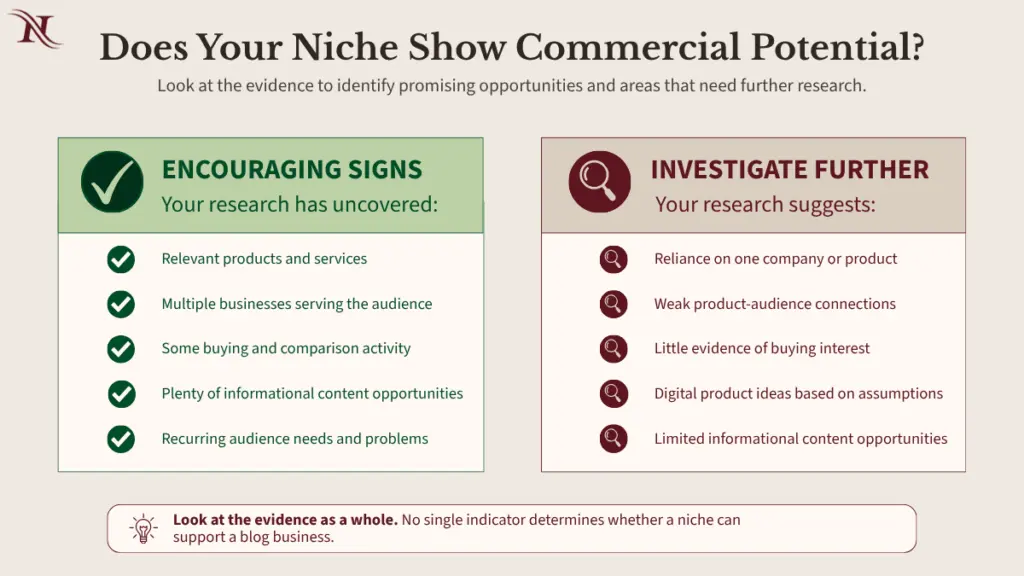
These aren’t pass-or-fail criteria. A lack of obvious buying searches, for example, doesn’t automatically make a niche unsuitable. Some audiences have commercial needs that are less visible in search results, while others may be better served through a different approach.
The important thing is to recognise where you have evidence, where you have promising possibilities and where you still have unanswered questions.
Look at the Evidence as a Whole
You also don’t need every indicator to be present. A niche might have relatively few obvious product comparisons but plenty of relevant services and recurring audience needs. Another might have a strong product market but fewer obvious digital product opportunities.
What matters is whether the evidence, taken together, gives you a credible reason to believe the niche could support a blog business.
And don’t confuse commercial potential with guaranteed profitability. Your eventual results will depend on many factors, including the quality of your content, your ability to reach the right audience and how effectively you meet their needs.
Let’s Get Your Niche’s Earning Potential in Focus
Choosing a blog niche involves more than finding a topic people are interested in. You also need to consider whether that topic has the depth and commercial opportunities to support the kind of blog business you want to build.
Your earlier research should have helped you establish whether people are interested in your topic and whether there’s room for your blog. This final check adds another important piece of the picture: whether there are products, services, businesses and audience needs that could create realistic opportunities to earn money.
You don’t need to have every income stream planned before you start. You simply want enough evidence to feel confident that you’re building around a genuine audience with needs you can help meet.
Take your time, follow the evidence and avoid choosing a niche based solely on what someone else claims is profitable. A blog is a long-term project, and the strongest foundation is one that combines genuine audience interest with realistic opportunities to create value.
I’d Love to Hear From You!
Have you discovered any promising commercial opportunities in your chosen niche? Or are you still unsure whether there’s enough earning potential to turn it into a blog business?
Drop a comment below and tell me what you’ve found. I’d love to hear about your niche and help you think through any questions or concerns you might have.
Happy Niche Researching!

NEXT STEP
Ready to turn your niche idea into a blog?
Once you’ve researched your niche and feel confident about its potential, the next step is to start building your blog. My guide to How to Start a Blog and Make Money Online walks you through the process, from getting started to building the foundations of your online business.
Helpful Guides to Read Next
These beginner-friendly guides will help you keep building your blog step by step.

Jessie
Founder, nomorerush.com
Hi, I’m Jessie — founder of No More Rush. I help beginners build profitable, beginner-friendly blogs without the overwhelm or unrealistic expectations you see online. Everything here is built around simple, structured steps so you always know what to do next.