Choosing a blog niche is a big decision, but you don’t necessarily have to get it perfect before you start. What you can do, however, is investigate your idea before committing months of your time to it.
A niche might sound promising on paper, but that doesn’t necessarily mean people are actively looking for information about it, that there are enough questions to build a blog around, or that a new website has a realistic opportunity to compete.
Fortunately, you don’t need an expensive SEO subscription to carry out a useful first round of research. Several free tools and resources can give you valuable insights into search interest, audience questions and the competitive landscape. This guide will show you how to use them to validate a blog niche before you commit.
Validation can’t guarantee success, but it can help you reduce the risk of committing to an idea that shows little evidence of opportunity.
If you’re still trying to decide what your niche should be, my guide to How to Choose a Niche for a Blog covers the broader process of finding, refining and assessing a niche before you commit.
If you already know what you want to blog about, great. That’s exactly where we’ll start.
1. What are you actually trying to validate?
Before opening Google Trends or any other tool, it’s worth being clear about what you’re actually trying to find out.

You’re not trying to prove that your niche is going to become a successful blog. You’re trying to answer a handful of practical questions such as:
- Are people genuinely interested in this subject?
- Are they actively looking for information about it?
- Do they have enough different questions and problems to support ongoing content?
- Is the interest relatively consistent, or does it appear to be a short-lived trend?
- What does the existing search landscape look like?
- Are there smaller or more specialised websites competing alongside the biggest brands?
- Is there an opportunity for a new site to create something genuinely useful?
These questions give you a much more realistic picture of a niche than a single keyword’s search volume ever could.
Demand isn’t the same as opportunity
This is one of the most important things to understand when validating a niche. A topic can have huge demand and still be extremely difficult for a new website to compete in.
Equally, a smaller niche can have a more modest audience but offer a realistic opportunity for a focused website to become useful and visible. So don’t approach validation with the mindset of needing to find a niche with massive search volume.
Instead, think about finding evidence that people have ongoing needs related to this topic, and whether there’s a realistic opportunity for your site to serve those needs. That’s what the checks in this guide are designed to uncover.
2. Check search interest with Google Trends
One of the easiest places to start the validation process is Google Trends, which lets you see how interest in a search term has changed over time.
You don’t need to understand complicated SEO metrics to get useful information from it. You’re simply looking for patterns that help you understand whether interest in your topic appears to be:
- steady
- growing
- declining
- seasonal
- or driven by a temporary spike
Look at the bigger picture
It’s tempting to enter your topic into Google Trends, see a recent upward line and assume you’ve found a promising niche. But don’t stop there. Try looking at a longer time frame as well as the recent past.
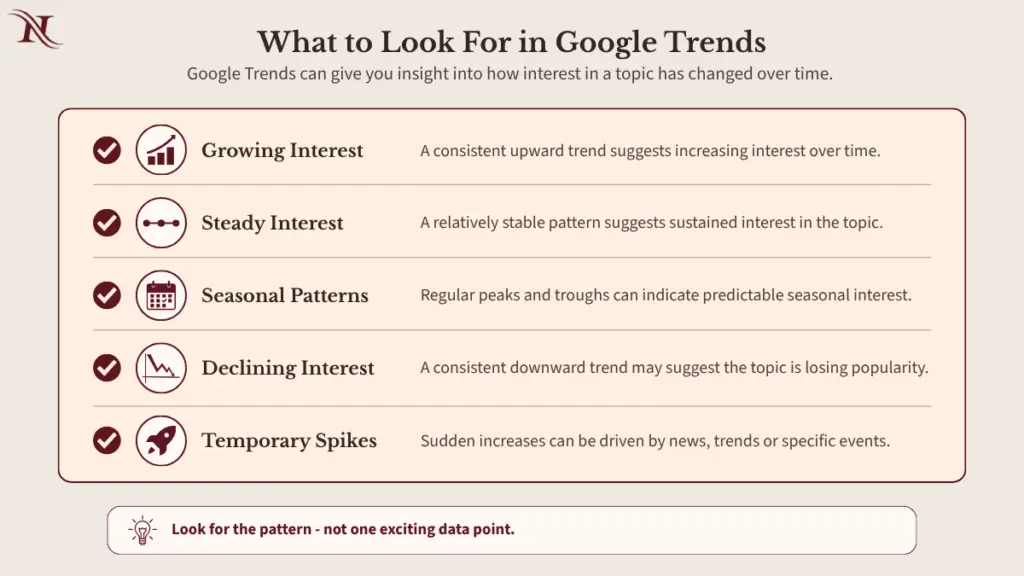
For example, a topic might appear to be taking off when viewed over the last 12 months. Looking back five years might reveal that the same spike happens every year around a particular event or season.
That’s very different from sustained growth. Similarly, a topic that’s currently receiving lots of attention might turn out to be something that peaked several years ago and has been steadily declining ever since.
You’re not necessarily looking for a perfectly flat or constantly rising graph. You’re looking for a pattern that makes sense for the type of blog you’re planning to build.
Pro Tip: Compare More Than One Time Frame
Check both recent interest and the longer-term pattern. A promising 12-month trend can look very different when you examine the past five years.
Ask yourself: Is there evidence of ongoing interest, or are you looking at a temporary moment in time?
Check for seasonality
Some topics naturally have predictable peaks and troughs. Christmas crafts, gardening, holiday planning and tax-related searches are obvious examples.
Seasonality isn’t necessarily a problem. A seasonal niche can still be perfectly viable. The important thing is to understand the pattern before you commit.
If you discover that interest disappears almost completely for most of the year, you’ll want to take that into account when thinking about your content strategy and expectations.
Compare related search terms
Google Trends also allows you to compare search terms. This can be useful when several phrases describe broadly the same subject.

Rather than assuming the first phrase that came to mind is the best representation of your niche, compare related terms and see whether one is consistently more popular, whether interest is shifting, or whether they follow different seasonal patterns.
Again, the goal isn’t to find a magic keyword. You’re trying to understand how people actually express their interest in the topic.
Watch out for sudden spikes
A sharp increase in search interest can look exciting, but it’s important to ask what’s causing it. For example, is it:
- a new product launch?
- a viral story?
- a celebrity?
- a major news event?
- a temporary social media trend?
- a recurring seasonal event?
If so, the spike may tell you very little about whether people will still be interested six months or two years from now. However, a temporary spike isn’t automatically a reason to reject a niche. It’s simply a reason to investigate further.
What Google Trends can’t tell you
It’s also important not to rely on Google Trends to answer questions it isn’t designed to answer. It can’t tell you:
- whether your blog will rank
- how much money the niche could make
- whether readers will trust your content
- whether you’ll be able to create better content than existing sites
- whether people will buy products or services
- whether your particular approach to the topic will succeed
That’s why Google Trends is only one part of the validation process. You’re gathering evidence from several different sources and looking at what that evidence tells you as a whole.
Don’t ask, “Does Google Trends say this is a good niche?” Ask, “What does the search-interest pattern tell me about this topic?”
3. Look at what people are actually searching for
Google Trends can give you insight into how interest in a topic has changed over time. But there’s another question you need to answer:
What are people actually trying to find out?
Google’s own search features can help answer that. Google Autocomplete, People Also Ask and Related Searches reveal the questions and problems people associate with your niche.

More importantly, they can help you see whether those needs are varied enough to support a blog. You’re not simply collecting potential post titles. You’re looking for patterns.
Start with Google Autocomplete
Go to Google and start typing your main niche topic into the search box. Google will suggest related searches as you type.
Try entering your niche on its own first, then add different words and phrases to uncover different types of searches. For example, you might try:
- [niche] how to
- [niche] for beginners
- [niche] best
- [niche] vs
- [niche] problems
- [niche] tips
- [niche] mistakes
- [niche] alternatives
- [niche] cost
You don’t need to use every variation. The goal is simply to explore the different ways people search around the subject.
Look for recurring needs
As you work through the suggestions, start grouping what you find. You might notice searches relating to:
Learning – People want to understand the basics.
Problems – People are trying to fix something that isn’t working.
Decisions – People are comparing options or deciding what to buy or use.
How-to questions – People want instructions or practical guidance.
Improvement – People already know the basics and want better results.
This is more useful than simply counting autocomplete suggestions. You’re looking for evidence that people have multiple reasons to seek information about the topic.
Check People Also Ask
Next, search for some of the questions and phrases you’ve discovered. You’ll often see a People Also Ask box containing related questions.
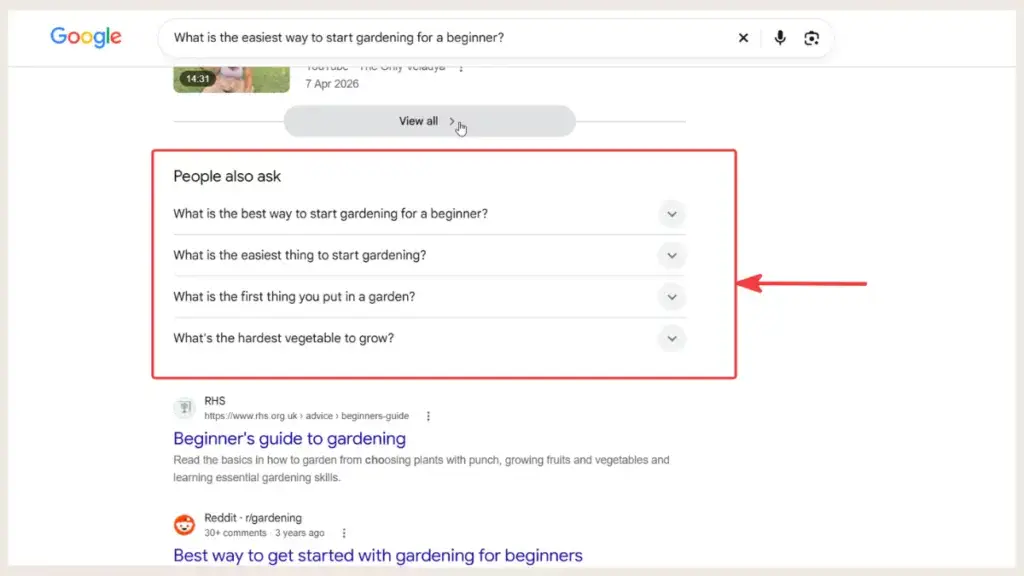
Don’t just read the questions and move on. Look at what they reveal about the audience. For example, are people asking:
- basic beginner questions?
- “how do I…” questions?
- troubleshooting questions?
- questions about different options?
- questions about costs or products?
- questions that arise after they’ve already tried something?
If the questions cover several different aspects of your niche, that’s a useful signal. It suggests people have different problems and needs as they explore the subject.
Look beyond the first four questions
One useful trick is to click on relevant questions to expand the People Also Ask box. Google will often reveal additional related questions as you do this.
You don’t need to record every one. Instead, look for themes that keep appearing. If you repeatedly see questions around choosing, using, comparing, fixing and improving something, that’s stronger evidence of a real audience need than one isolated query.
Don’t forget Related Searches
At the bottom of a Google results page, you’ll often find a Related Searches (People Also Search For) section. These can reveal another layer of the language people use when searching for the subject.

Again, don’t treat every suggestion as a potential article. Instead, ask yourself what these searches reveal about people’s needs.
You may discover related problems, alternative solutions, adjacent topics or questions you hadn’t considered. These patterns can reveal the wider audience around your niche.
Look for variety, not just volume
This is where the individual search signals start to form a bigger picture. Imagine you search a potential niche and discover hundreds of searches, but almost all of them are variations of the same question.
That doesn’t necessarily tell you much about the breadth of the audience’s needs. Now imagine another niche where your research reveals questions from people who are:
- just getting started
- trying to solve problems
- comparing different approaches
- looking for products or tools
- trying to improve their results
- tackling more advanced questions
That’s evidence of something more valuable: a range of ongoing needs. You’re now beginning to see an audience rather than just a keyword.
A useful validation question isn’t “How many searches are there?” It’s “What are people actually trying to accomplish?”
That shift in perspective will help you interpret the rest of your research too.
The Key Question
Don’t just ask how many searches you can find. Ask whether those searches reveal different problems, goals and decisions that your blog could help with.
Keep a simple record of what you find
You don’t need to create a complicated keyword database at this stage. A simple document or spreadsheet is enough. As you investigate, record some of the recurring questions or themes you discover and group them into broad categories such as:
|
What people are looking for |
Examples you may find |
|---|---|
|
Beginner questions |
How to start a vegetable garden; easiest vegetables to grow |
|
How-to questions |
How to grow tomatoes in pots; how often to water seedlings |
|
Problems to solve |
Why are my tomato leaves turning yellow?; why aren’t my seeds germinating? |
|
Comparisons |
Raised beds vs. in-ground gardens; compost vs. fertiliser |
|
Products or tools |
Best gardening tools for beginners; what equipment do I need to start gardening? |
|
Improvements |
How to increase tomato yields; how to improve garden soil |
|
Other recurring needs |
Gardening month by month; vegetables that grow well in small spaces |
You may find that some searches fit into more than one category, and that’s perfectly fine. The aim isn’t to classify every query perfectly, but to identify recurring needs and see whether people are looking for different kinds of help within the same topic.
You’re also not building your final content plan yet. Instead, you’re collecting evidence about the audience.
If the same types of questions appear across Google Autocomplete, People Also Ask and Related Searches, that’s particularly useful: you’re seeing the same underlying needs across several search features rather than relying on one source.
What would concern me?
A niche isn’t necessarily a bad idea just because you don’t find hundreds of questions. But I’d pause if your research consistently reveals:
- Very few searches beyond your original phrase
- Almost no related questions or problems
- Little variation in what people want to know
- Interest that appears to be tied to a single temporary event
At this point, you don’t need to make a final decision. You’re simply gathering evidence and looking for patterns.
Next, we’ll explore another way to uncover related questions and recurring audience needs using AnswerThePublic.
4. Use AnswerThePublic to explore audience questions
Google’s search suggestions and People Also Ask results can reveal what people are looking for. If you’d like another way to explore related searches, AnswerThePublic can help you discover additional questions and see how they connect.
However, there’s one thing to know before you start: AnswerThePublic’s free version has limitations. You can only run a limited number of searches, and some suggestions and data are locked behind a paid plan.
You can still explore the available results, including its expandable People Also Ask section, but you may not be able to access every question the tool identifies.
Fortunately, you don’t need to pay for a subscription to validate your niche. Think of AnswerThePublic as an optional source of additional ideas, rather than a tool you must use to complete your research.
Look for patterns in the questions
Enter your main niche topic into AnswerThePublic and explore the available results. Depending on the report and the data available, you may find searches grouped around words such as:
- what
- why
- how
- can
- where
- when
You may also discover comparisons, related searches and other question patterns.
Rather than copying every suggestion into a list of potential blog posts, look for questions that add something new to your research. You might uncover an unfamiliar problem, a comparison people are making or a related topic that hasn’t appeared in your Google searches.
The aim is to discover additional themes, not to repeat the same audience needs you’ve already identified.
The questions may also reveal different stages of the reader journey. Some people are looking for basic explanations, while others are comparing options, troubleshooting problems or trying to improve their results.
Don’t confuse a long list with strong demand
AnswerThePublic can display a range of related queries, but quantity alone doesn’t validate a niche.
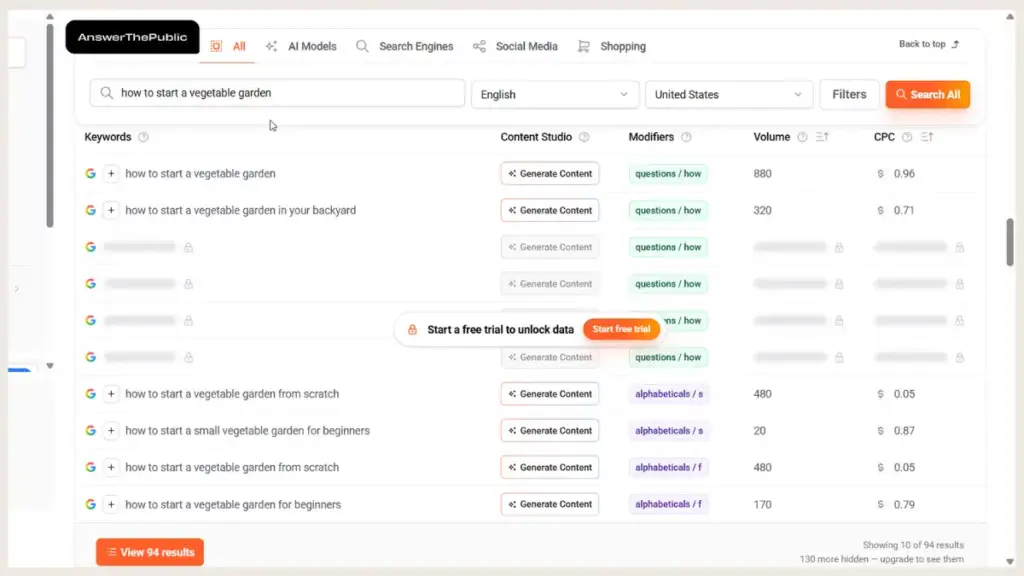
Some suggestions may be different ways of expressing essentially the same question. For example:
- How do I fix X?
- Why isn’t X working?
- What should I do when X doesn’t work?
These might all reflect one underlying problem rather than three distinct audience needs. Instead, ask yourself:
What recurring problems, questions and goals can I see beneath the individual searches?
That’s the information that matters for validation. You’re trying to understand the audience, not simply collect a long list of keywords.
Look for recurring themes
As you explore the available results, group similar questions together. You might notice themes such as:
Getting started — People want to understand the basics.
Choosing — People need help deciding between different options.
Troubleshooting — People are encountering problems and looking for solutions.
Improving — People want better results from something they’re already doing.
Buying decisions — People are researching products, tools or services.
Understanding — People want explanations rather than instructions.
You don’t need a complicated spreadsheet. A few notes are enough to help you recognise recurring themes and compare them with the patterns you’ve already found through Google.
Investigate potential content gaps in Google
AnswerThePublic can help you discover questions, but it doesn’t tell you whether those questions are being answered well by existing websites. For that, you’ll need to do a little more research.
Choose a few relevant questions from your findings and search for them directly in Google. Examine the results and ask yourself:
- Do the pages provide useful, detailed answers?
- Are the answers superficial or missing important information?
- Are the results aimed at experienced readers when beginners might need simpler explanations?
- Do several pages cover the question from different angles, or is there room for a more comprehensive resource?
Don’t assume a question is underserved simply because it appears in AnswerThePublic. The actual search results will help you judge whether there’s a potential opportunity to provide something more useful.
We’ll look at this in more detail in the next section, where we’ll examine the SERPs and consider whether a new blog has a realistic opportunity to compete.
For now, the important question is, are there real people with recurring questions and needs related to this topic?
Use the results alongside your Google research
This is where the different validation checks start to work together. If AnswerThePublic reveals recurring questions that also appear in Google Autocomplete, People Also Ask or Related Searches, you’re beginning to see a consistent pattern.
That gives you more useful evidence than relying on a single tool or a long list of keywords. Each source helps you examine a different aspect of the niche:
Google Trends → Is there ongoing interest?
Google search features → What are people searching for?
AnswerThePublic → What additional questions and related themes can you uncover?
SERPs → What do the existing search results tell you about the competition and the opportunity to add value?
Don’t validate a niche by counting keywords. Validate it by looking for evidence of real, recurring audience needs.
Once you’ve gathered evidence that people are searching for information about your topic, there’s another important question to consider:
What happens when you actually search for those things?
That’s where we’ll examine the search engine results pages (SERPs) and assess whether there’s a realistic opportunity for a new blog to compete.
5. Check the SERPs: Is there a real opportunity for a new blog?
You’ve established that people are searching for your topic and that there are a range of questions and needs surrounding it. Now it’s time to look at what happens when those people actually search.
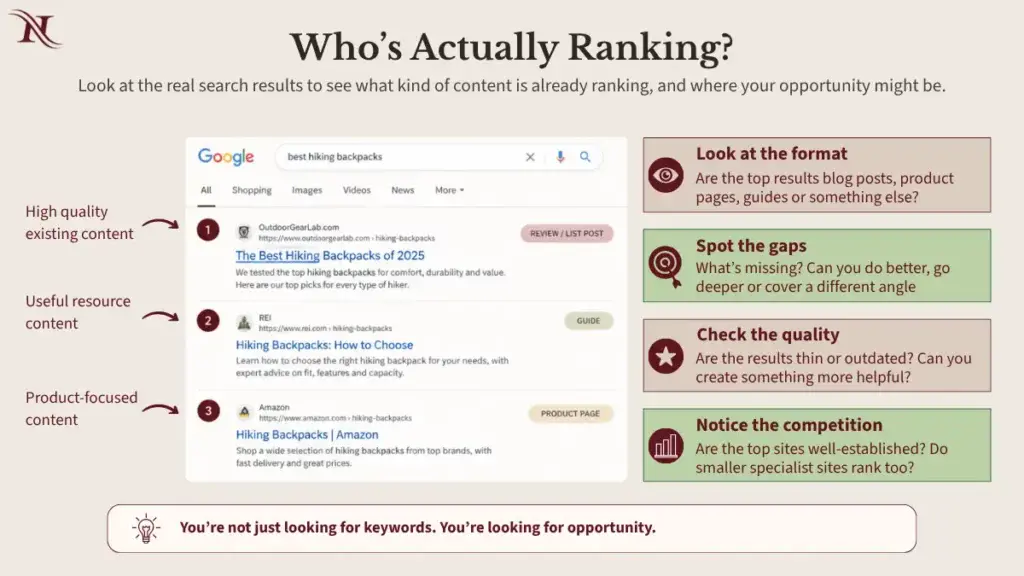
This is where you can get a much better sense of the competitive landscape. And you don’t need advanced SEO knowledge to do a useful SERP check. You simply need to look at a selection of relevant searches and ask:
Who is ranking, what are they offering, and is there room for a new site to add something genuinely useful?
Don’t judge the whole niche from one search
Start with several of the questions and topics you’ve uncovered during your research. Choose a mixture of searches rather than repeatedly searching your main niche phrase. For example, you might look at:
- a beginner question
- a how-to query
- a problem-solving query
- a comparison
- a product-related search
- another question that appears repeatedly in your research
This gives you a much more representative picture of the search landscape.
Look at who’s ranking
Take a look at the first page of results. What types of websites do you see? You might find:
- large established brands
- specialist websites
- individual bloggers
- smaller niche sites
- retailers
- forums and communities
- YouTube videos
- other types of websites
Don’t automatically assume that a niche is impossible because a big brand appears at the top. Instead, look at the overall mix of results. If the searches you investigate are consistently dominated by huge, established websites, that’s worth taking into account.
On the other hand, if smaller specialist websites and independent publishers also appear, that can be an encouraging sign. It suggests there may be opportunities for focused sites to appear alongside larger competitors, although it doesn’t guarantee that your own blog will rank.
Use MozBar for a quick look at authority
One of the hardest things to judge when you’re new to SEO is how established the websites you’re looking at actually are.
You can make a basic assessment by looking at the sites themselves, but a free browser extension such as MozBar can give you some additional context. MozBar displays metrics including:
- Domain Authority (DA) — Moz’s predictive score, from 1 to 100, estimating how likely a domain is to rank in search results relative to other domains.
- Page Authority (PA) — Moz’s predictive score, from 1 to 100, estimating how likely an individual page is to rank in search results relative to other pages.
You can use these metrics while looking through the search results to get a rough idea of how strong the sites appearing on the first page are.
But don’t treat DA or PA as Google ranking scores
This is important. DA and PA are third-party Moz metrics, not metrics used by Google to determine rankings. A high-DA website isn’t automatically going to outrank a lower-DA website, and there’s no magic DA number that tells you whether you can rank for a keyword.
Instead, use the metrics as one piece of context. For example, if you search several relevant queries and find that the first page is consistently filled with very strong, established domains, that’s worth taking into account.

If you also see smaller sites with lower authority appearing on page one, that’s potentially more encouraging.
The question isn’t:
“Are all these sites below DA 30?”
It’s:
“Does this SERP appear to leave room for sites that aren’t already enormous?”
That’s a much more useful question.
Third-party authority metrics can help you understand the SERP, but they shouldn’t be used as a simple “easy to rank” score.
Look at the quality of the existing content
Authority isn’t the only thing that matters. Open some of the results and actually look at what they’re offering. Ask yourself:
- Does the content properly answer the question?
- Is it up to date?
- Is it written for the audience you’re interested in serving?
- Does it provide practical information?
- Does it cover the subject thoroughly?
- Is anything important missing?
- Does the page answer the searcher’s question quickly and clearly?
You’re not looking for excuses to declare existing content “bad.” You’re trying to understand what is already available to the reader. If the existing results are genuinely excellent, comprehensive and authoritative, that’s important evidence.
If you repeatedly find content that is outdated, superficial, poorly targeted or doesn’t quite answer what the searcher is asking, you may have identified an opportunity to approach the subject differently.
Remember, you’re not necessarily looking for weak websites to compete against. You’re looking for evidence that a focused site could contribute something valuable.
Smaller competitors, content gaps and search results that don’t fully meet the reader’s needs are all worth investigating, but none guarantees an opportunity to rank.
Look at the type of content Google is ranking
The format of the results can tell you something too. For example, you might see:
- detailed tutorials
- comparison articles
- product reviews
- videos
- forum discussions
- category pages
- product pages
- visual guides
This helps you understand search intent. If someone searches for “how to repair X” and Google consistently shows detailed tutorials, creating another page that simply describes the history of X probably isn’t going to satisfy the same search intent.
Likewise, if the results are dominated by product pages and shopping results, that’s telling you something different about what searchers want.
You’re essentially asking:
What does Google appear to believe would be most useful for this search?
And then:
Could my site create something that genuinely satisfies that need?
Check several searches before you decide
One promising SERP doesn’t validate an entire niche, and one highly competitive search doesn’t necessarily invalidate it. Check several relevant queries and look for patterns.
You may find that some are dominated by major brands, while others feature smaller specialist sites, forums, outdated content or answers that leave room for improvement.
That variation can help you identify where potential opportunities might exist within the wider niche.
So, is the niche too competitive?
Don’t try to answer this with a single number. Instead, step back and consider the evidence you’ve collected.
More encouraging signs
- Smaller or specialist sites appear in the results.
- You can identify queries where the existing content isn’t particularly strong.
- Search results include a variety of publishers rather than only enormous brands.
- You can see clear gaps in how existing content serves the audience.
- Different types of searches produce different opportunities.
Reasons to investigate further
- Almost every relevant query is dominated by major established sites.
- Existing results are consistently comprehensive and difficult to improve upon.
- The SERPs strongly favour websites with substantial authority and brand recognition.
- You can’t identify a meaningful way your site would provide additional value.
None of these automatically means “don’t start this blog.” They’re simply pieces of evidence that should influence your decision.
You’re not looking for a competition-free niche. You’re looking for evidence that a focused website can contribute something valuable.
And there’s one final thing to check before you make that decision: does the audience have enough different needs to support an entire content ecosystem, rather than just a handful of articles?
6. Look for a real content ecosystem
By now, you’ve gathered evidence about search interest, audience questions and the competitive landscape. Now take a step back and ask one more important question:
Is there enough going on here to support an entire blog?
A viable blog niche needs more than one popular topic. You want to see evidence that people have multiple, related needs you could help them with over time. This is what I mean by a content ecosystem.
What does a content ecosystem look like?
Imagine your research reveals people looking for information at several different stages. They might want to:
Learn → understand the basics
Choose → compare options and make decisions
Do → follow tutorials and get started
Solve → fix problems when something goes wrong
Improve → get better results
Buy → research products, tools or services
Those needs can potentially support different types of useful content.
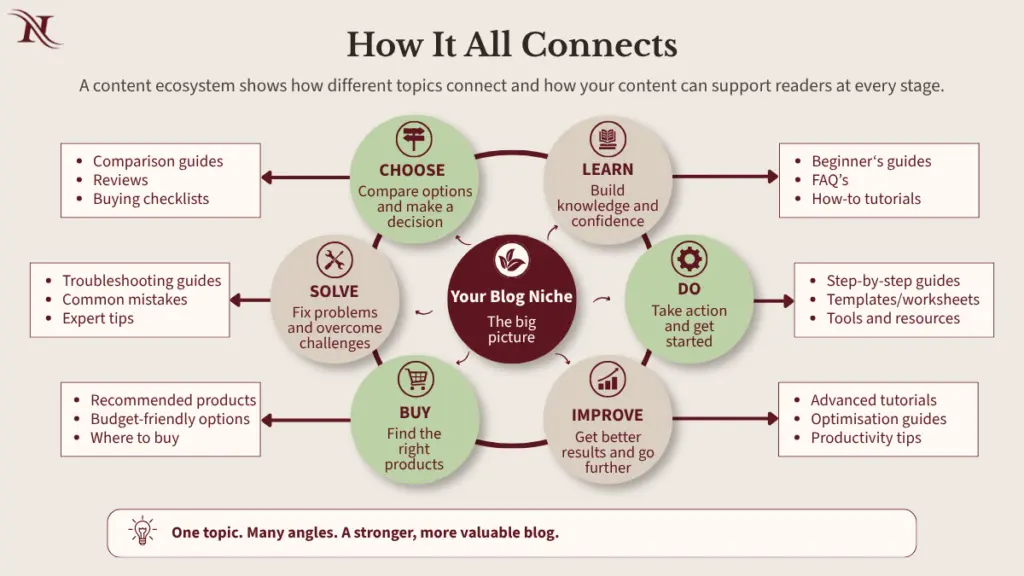
That’s a much stronger signal than simply finding a long list of keywords.
Look back at your research
Rather than starting a new brainstorming session, go back to the evidence you’ve already collected:
- Google Autocomplete
- People Also Ask
- Related Searches
- AnswerThePublic
- the searches you investigated in the SERPs
Do you keep seeing different questions and problems? Are several distinct themes emerging? Can you see people at different stages of learning or doing? If so, you’re starting to see the shape of a genuine content ecosystem.
Look for different types of audience needs
A viable niche doesn’t need hundreds of completely unrelated subjects. The topics should be connected, but you ideally want enough variety that your blog won’t run out of useful things to say after a handful of posts.
For example, you might find opportunities around:
Beginner questions – People who are new to the subject need explanations, definitions and getting-started guidance.
Practical how-to content – Once they understand the basics, they want to know how to actually do things.
Problem-solving – People inevitably run into difficulties. Searches about mistakes, common problems and troubleshooting reveal another layer of need.
Comparisons and decisions – People may need help choosing between products, methods, tools or approaches.
Improvement and optimisation – More experienced readers may want to improve their results or solve more specific problems.
Related topics – You may also discover closely connected subjects that naturally belong to the same audience.
The point isn’t that every niche needs all six. You’re looking for evidence of more than one type of need.
Don’t just count potential blog posts
You might be able to create 50 article ideas by taking one keyword and endlessly changing the wording. That doesn’t necessarily mean you’ve found a strong content opportunity.
Compare:
“Best X for beginners”
“Best X for small spaces”
“Best X under €50”
“Best X for beginners in 2026”
Those might technically be four article ideas, but they could all serve essentially the same underlying need. Now compare that with:
How do I get started with X?
Why isn’t X working?
Which type of X should I choose?
What’s the difference between X and Y?
What equipment do I need?
How do I improve my results?
Those searches suggest different problems and decisions rather than simple variations of the same keyword. That’s the kind of depth you’re looking for.
Look for a journey, not just a list
One of the strongest signs of a useful content ecosystem is being able to see a natural journey through the subject:
Discover → Learn → Try → Troubleshoot → Improve → Compare → Buy
You don’t need to map out your entire content strategy at this stage. You’re simply asking whether the audience’s needs develop naturally as they learn and use the subject.
If they do, that’s encouraging. It suggests your blog could potentially become a useful resource that grows with the reader, rather than a collection of disconnected articles targeting individual keywords.
What if you don’t find much depth?
Don’t panic if your initial research doesn’t produce an enormous list of topics. You’re not trying to prove that your niche can support thousands of articles. A smaller niche can still be perfectly viable. Instead, pay attention to what the evidence is telling you.
Encouraging signs
- You keep discovering new questions as you research.
- The questions cover different aspects of the subject.
- People appear to have different problems and goals.
- You can see beginner and more advanced needs.
- Related topics naturally connect back to the same audience.
- The SERPs reveal different types of content and search intent.
Potential warning signs
- Almost every search revolves around one very specific question.
- Most questions are simply variations of the same problem.
- You struggle to find related needs beyond your original topic.
- Interest appears to be tied to a single product, event or trend.
- The audience seems to have very limited reasons to return for additional information.
Again, none of these is an automatic “don’t start this blog” signal. You’re building a picture from several pieces of evidence.
A strong niche isn’t necessarily one with endless topics. It’s one where you can see a genuine audience with enough different needs to make your content useful over time.
You’ve now assessed whether your niche has enough variety and depth to support useful content over time. Next, bring that evidence together to decide whether the idea is worth pursuing.
7. Bring the evidence together
By this point, you’ve looked at your niche from several different angles. You’ve checked whether interest is sustained, explored what people are searching for, examined the search results and considered whether there’s enough depth to support a blog. Now it’s time to put those observations together.
The easiest way to do this is with a simple validation worksheet. You don’t need to calculate a complicated SEO score. In fact, I’d avoid doing that.
Instead, record what you found, identify anything that concerns you, and make a judgement based on the overall picture. For this exercise, you could use a spreadsheet, a notes document or even a piece of paper.
Example: How to record your niche validation findings
Here’s an example of how you might record your findings. These are illustrative observations, not results from research into a specific niche. Your own findings will depend on the topic you’re investigating.
|
Validation check |
What I found |
Good signs |
Concerns |
|---|---|---|---|
|
Google Trends |
Interest has been fairly steady |
Ongoing interest |
Seasonal dips |
|
Google Autocomplete |
Suggestions cover several related needs |
Variety of searches |
Some suggestions are repetitive |
|
People Also Ask |
Questions cover beginner and practical topics |
Different audience needs |
Few questions on some subtopics |
|
AnswerThePublic |
Several recurring question themes |
Multiple related needs |
Some queries repeat the same problem |
|
SERPs |
Established sites and smaller specialist sites appear |
Some varied competition |
Major sites dominate certain searches |
|
Existing content |
Some guides are useful but incomplete |
Opportunities to add value |
Strong competitors on key topics |
|
Content ecosystem |
Learning, troubleshooting and comparison topics emerge |
Several connected content areas |
Limited depth in some areas |
You don’t need to fill every box with detailed data. A few useful observations are enough. For example:
Google Trends: “Interest has been fairly steady for five years, with predictable seasonal peaks.”
SERPs: “Major sites appear frequently, but several smaller specialist websites also rank.”
Content ecosystem: “Found beginner, troubleshooting, comparison and product-related questions.”
You’re creating a body of evidence, not trying to produce a scientifically precise score.
Once you’ve recorded your findings, step back and look at the overall pattern. You don’t need every signal to be positive, and one concern doesn’t automatically mean you should abandon the idea.
What matters is whether the evidence, taken together, gives you enough reason to proceed, investigate further or reconsider your niche.
The following framework can help you decide what to do next.

Three possible validation outcomes
Rather than giving your niche a numerical score, I’d use three broad outcomes.
🟢 Strong evidence
Your research has uncovered consistent signs of audience interest, varied needs and a potentially realistic opportunity for a focused website.
Verdict: Your niche looks worth pursuing.
You still won’t know how successful the blog will be, but you’ve found enough positive evidence to justify moving forward.
🟡 Some concerns
There are positive signs, but you’ve also uncovered potential problems such as heavy competition, seasonality or limited depth.
Verdict: Don’t commit just yet. Investigate the concerns further or consider whether there’s a more specific opportunity within the subject.
You don’t necessarily need to abandon the idea. You simply need to understand the risks before making your decision.
🔴 Weak evidence
Your research consistently suggests limited or temporary interest, very few genuine audience needs or little realistic opportunity for a new site to contribute something useful.
Verdict: Reconsider the idea before investing significant time in it.
And remember: changing direction at this stage isn’t failure.
That’s the whole point of validation.
A good validation process doesn’t tell you whether your blog will succeed. It helps you decide whether there’s enough evidence to make the investment of your time worthwhile.
Keep your evidence for later
There’s another reason I’d recommend recording your findings rather than simply looking at the tools and moving on.
Your research can become useful after you decide to proceed. The questions you discovered can help shape your initial content plan.
The SERPs you examined can show you what readers expect to find. And the gaps you’ve noticed can help you think about how your site could provide something genuinely useful.
Your validation research doesn’t have to end when you decide:
“Yes, I’m going to build this blog.”
It can become the starting point for what you create next.
Want to go deeper? Paid SEO tools can give you more data
You don’t need an expensive SEO platform to carry out the initial validation process in this guide. The free tools we’ve covered can tell you a surprising amount about search interest, audience questions and the competitive landscape.
However, if you’re serious about a particular niche and want to investigate it in more detail, paid SEO tools can provide considerably more data.
Platforms such as Semrush, Ahrefs and Moz Pro combine multiple SEO research features in one place, making it easier to investigate things that are difficult to assess using free tools alone.
What can paid tools help you investigate?
Depending on the platform, you can explore areas such as:
- estimated search volumes
- keyword difficulty and competition
- related keywords and search terms
- competitor keyword rankings
- competing websites
- backlink profiles
- traffic estimates
- content gaps
- SERP features
- commercial search intent
For example, instead of simply seeing that several competitors appear in Google, you can investigate which keywords they’re ranking for, how much organic traffic those keywords may be generating and what other websites are competing for the same searches.
That can be particularly useful if you’ve found a potentially promising niche but the competition looks strong and you want more information before making a decision.
You don’t need all of them
You also don’t need to subscribe to several SEO platforms just to start a blog. If you’re a beginner validating your first niche, the free process in this guide is a perfectly sensible starting point. Paid tools become more useful when:
- you’re taking SEO seriously as part of your business
- you’re researching several potential niches
- you want to analyse competitors in greater depth
- you’re planning a substantial content strategy
- you want detailed keyword or backlink data
More data isn’t automatically better if you don’t yet know what to do with it. A beginner can easily become overwhelmed by hundreds of keywords, difficulty scores and competitor reports when the basic question is simply:
“Is there enough evidence here for me to invest my time in this niche?”
For that question, you can get surprisingly far without spending anything.
Start with the free evidence. Pay for deeper data when you have a reason to need it.
A note on SEO metrics
If you do move on to paid tools, remember that their metrics are estimates and third-party measurements, not Google’s own ranking scores.
Use them to identify patterns and compare opportunities rather than treating a particular keyword difficulty or authority number as a guarantee that you will — or won’t — rank. The same principle applies to the DA and PA metrics discussed earlier.
What niche validation can’t tell you
By this point, you should have a much clearer picture of your niche than you had when you started. You’ve looked at search interest, audience questions, the existing SERPs and the amount of content potential available.
But even strong validation can’t answer everything. There are some things no combination of Google Trends, search results or SEO tools can predict with certainty.
It can’t guarantee your blog will rank
You may find encouraging search results, smaller websites ranking and plenty of content opportunities. That doesn’t mean your new blog will automatically rank.
Search visibility depends on many factors, including the quality and usefulness of your content, your site’s overall credibility, competition, search intent and how your site develops over time.
Validation can tell you that an opportunity appears to exist. It can’t promise that you’ll capture it.
It can’t predict how quickly you’ll get traffic
A niche can have genuine demand and still take time to build an audience. Your research might show that people are searching for your topic, but it can’t tell you whether you’ll see meaningful traffic in three months, six months or longer.
That’s why validation should help you decide whether a niche is worth investing your time in, rather than setting expectations about when that investment will pay off.
It can’t tell you whether readers will trust your site
You can identify a gap in the search results, but filling that gap is another matter.
Your ability to create genuinely useful content, demonstrate relevant experience, provide accurate information and build trust with readers will still matter.
The research can show you where a need exists. What you do with that opportunity is up to you.
It can’t predict whether you’ll enjoy building the blog
This is something that tools simply can’t measure.
You might discover a niche with strong search interest, lots of content opportunities and relatively encouraging SERPs, and then discover six months later that you don’t actually enjoy writing about it.
Validation is only one part of deciding whether a blog idea is right for you.
If you’re still at the stage of choosing between different ideas, my guide to How to Choose a Niche for a Blog covers the broader decision-making process.
It can’t predict what will happen in the future
Search behaviour changes. New competitors appear. Products come and go. Trends rise and fall. Google changes how it presents and ranks information. Even a well-researched niche can change over time.
That’s why niche validation shouldn’t be treated as a one-time prediction of future success. It’s simply a way to make a better-informed decision with the information available to you now.
Validation is about reducing uncertainty, not eliminating it.
You can’t know exactly what will happen once you start a blog. What you can do is investigate the idea carefully, identify obvious warning signs and make sure there’s enough evidence to justify moving forward. And that’s a much better starting point than simply hoping your niche will work.
Let’s get your niche validated
Choosing a blog niche will always involve some uncertainty, but you don’t have to choose blindly. A little research can help you understand whether people are interested in your topic, what other websites are already covering it and whether there’s enough room to create something useful of your own.
By looking at search-interest patterns, exploring the questions people ask and examining the existing search results, you can build a much clearer picture of the opportunity in front of you.
You don’t need a niche with massive search volume, zero competition or endless content ideas. You need evidence of an audience with ongoing interests and needs that you can realistically help meet.
None of these checks can guarantee that your blog will succeed, but together they can help you recognise potential problems, identify opportunities and make a more informed decision before investing your time.
Don’t simply hope your niche will work. Take the time to investigate it, follow the evidence and give yourself the best possible foundation to build on.
I’d Love to Hear From You!
Have you discovered any promising validation results within your chosen niche? Or are you still unsure whether your idea has enough potential.
Drop a comment below and tell me about your niche and what you’ve found. I’d love to hear how your research is going and help you work through any questions or concerns!
Happy Niche Validating!

NEXT STEP
Ready to check whether your niche can make money?
You’ve established that people are interested in your topic. Now it’s time to investigate whether it has commercial potential. My guide to How to Tell If a Blog Niche Can Make Money will show you what to look for before committing to your blog idea.
Helpful Guides to Read Next
These beginner-friendly guides will help you keep building your blog step by step.

Jessie
Founder, nomorerush.com
Hi, I’m Jessie — founder of No More Rush. I help beginners build profitable, beginner-friendly blogs without the overwhelm or unrealistic expectations you see online. Everything here is built around simple, structured steps so you always know what to do next.