You’ve decided you want to start a blog, and you’re super excited. You’ve got plenty of niche ideas, and you’re ready to get started, but there’s just one problem. You have absolutely no idea which direction to take. Not because you have nothing to write about, but because you have too many things you’re interested in.
Maybe you love fitness, gardening and cooking. Perhaps you’re fascinated by photography, travel and DIY. Or maybe your list is so long that every time you think you’ve finally settled on a niche, another idea pops into your head.
If that sounds familiar, you’re certainly not alone.
Having lots of interests can make choosing a niche feel harder, but it can also be an advantage. You already have plenty of subjects you’re genuinely interested in exploring. The trick is working out which of those interests can form the basis of a focused blog, and whether some of them can actually work together.
In this guide, we’ll look at how to sort through your interests, find the connections between them, decide which ones belong together, and choose a direction you can realistically build a blog around.
First, Stop Trying to Find the “Perfect” Niche
When you have lots of interests, it’s easy to put enormous pressure on yourself to find the one perfect niche. You might worry that you’re making the wrong choice, that you’ll get bored with it later, or that you’ll regret leaving one of your other interests behind.
But your other interests aren’t going anywhere. You can continue enjoying them without turning every passion into a blog category. You may even discover later that one of them deserves its own website or becomes a natural addition to your existing blog.
For now, your goal is much simpler: find a direction that gives you enough focus to get started while still leaving you excited about creating content.
You don’t have to give up your other interests. You’re simply deciding which one deserves to be the focus of this particular blog.
Start With an Interest Brain Dump
Before you start judging your ideas, get them all out of your head. Grab a notebook, spreadsheet or blank document and write down everything you could imagine blogging about.
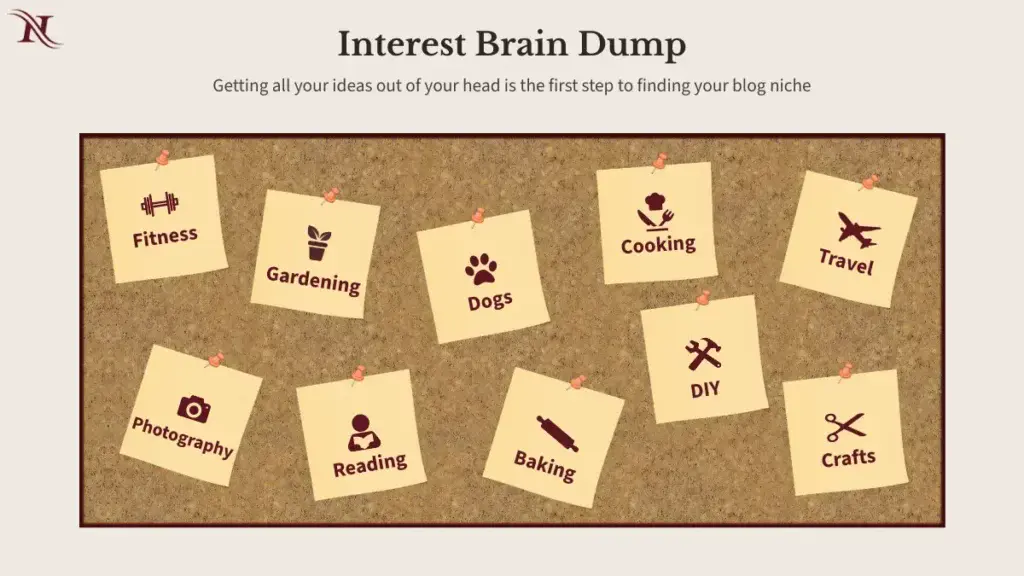
Don’t worry about whether an idea is profitable, competitive, too broad, too narrow or even particularly sensible at this stage. Just list it.
For example, your list might look something like this:
- Fitness
- Healthy cooking
- Gardening
- Photography
- Travel
- DIY
- Home organisation
- Dogs
- Reading
- Baking
- Crafts
- Personal finance
You might end up with five ideas or even fifty, and that’s fine. Just get them all out so that they’re easier to see and organise.
Don’t evaluate your ideas yet
The purpose of this exercise isn’t to choose your niche immediately. It’s simply to get your options out of your head so you can look at them more objectively.
Once everything is written down, you can start looking for patterns that aren’t always obvious when you’re thinking about each interest separately.
Look for Connections Between Your Interests
Now that you’ve completed the “brain dump” exercise, take a look at your final list and ask yourself the following question:
Which of these interests naturally belong together?
You might discover that several of your interests revolve around the same broader theme, audience or goal. For example, imagine you’re interested in:
- Running
- Yoga
- Healthy cooking
- Meal preparation
At first glance, those are four different topics. But they could potentially come together under a broader (umbrella niche) theme such as healthy living for busy women. Or perhaps your interests are:
- Gardening
- DIY
- Home organisation
- Decorating
Those could potentially form a blog focused on practical home & DIY.
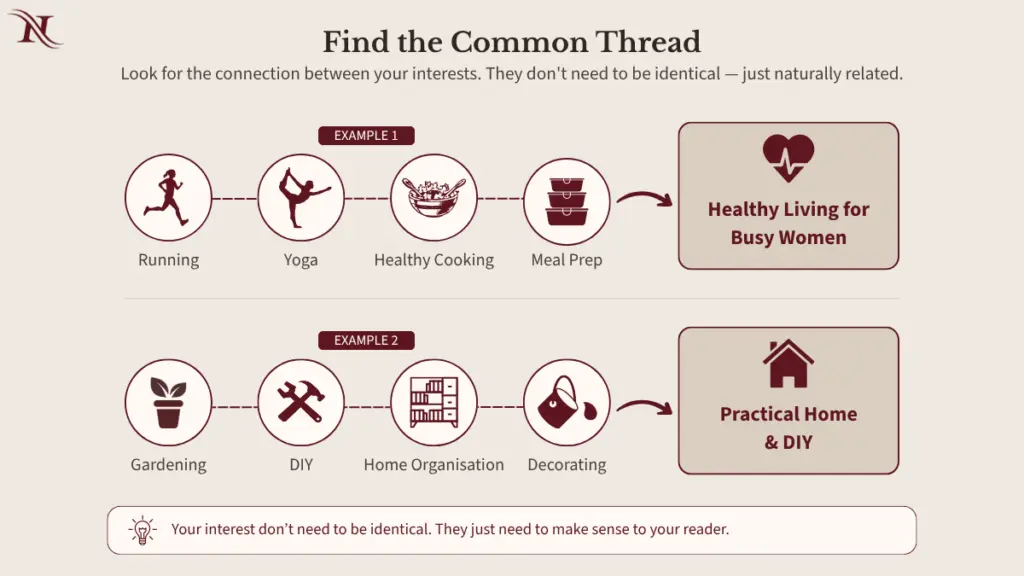
You don’t need every individual interest to be identical. You’re simply looking for a reason these topics make sense together. Ask yourself:
- Do these interests appeal to the same type of person?
- Do they relate to the same lifestyle?
- Do they help solve a similar problem?
- Do they support the same goal?
- Would someone interested in one reasonably want to read about the others?
If the answer is yes to several of these questions, you may have the beginnings of a blog concept that allows you to combine multiple interests without becoming unfocused.
Can You Combine Multiple Interests Into One Blog?
Yes, you absolutely can. You don’t necessarily have to choose between two or three related interests if they can comfortably live under one clear theme.
The important thing is that the combination needs to make sense from the reader’s perspective, not just from yours. For example, a blog covering:
Running + healthy meal prep
This combination makes intuitive sense. Someone interested in running may also be interested in nutrition and preparing healthy meals. Likewise:
Gardening + cooking
This could also work well if the blog focuses on growing and using your own food. But imagine combining:
Dog training + personal finance + gaming
You may genuinely love all three subjects, but there’s no obvious reason why someone interested in dog training would expect to find articles about gaming and budgeting on the same website.
That’s where combining multiple interests becomes a problem.
Your interests don’t necessarily need to be connected to each other. They need to be connected to your audience.
When Combining Interests Works
Combining multiple interests can work particularly well when they share:
The same audience
For example, fitness + nutrition + meal prep for busy women. All three topics can serve the same audience.
The same goal
For example, gardening + composting + growing your own food. Each topic contributes to the broader goal of becoming more self-sufficient.
The same lifestyle
For example, travel + photography + travel writing. These interests naturally overlap for someone interested in documenting and sharing their trips.
A clear overarching theme
The individual topics can be different while still making sense underneath one umbrella. The key is that a reader should be able to understand why these topics belong together.
Find the Common Thread
If several of your interests seem compatible, try to identify the common thread that connects them. This can help turn a collection of interests into an actual blog concept. For example:
|
Your interests |
Possible common thread/niche idea |
|---|---|
|
Fitness + healthy cooking + meal prep |
Healthy living for busy people |
|
Gardening + DIY + home projects |
Practical home living |
|
Travel + photography + writing |
Travel for creative people |
|
Baking + family meals + meal planning |
Cooking for busy families |
Notice that the common thread doesn’t have to be another huge, generic topic. You’re looking for something that explains why these particular subjects belong together. That might be:
- a particular type of person
- a particular lifestyle
- a particular goal
- a particular problem
- a particular experience
Once you find that connection, your blog can start to feel much more coherent.
Use the Audience Test
If you’re still unsure whether two or more interests can coexist, there’s one particularly useful question to ask:
Would the same person realistically be interested in all of these topics?
Imagine your ideal reader arriving at your blog. They’ve just read an article about one of your main topics. Would they naturally be tempted to click on another?
For example, if you’re writing about:
Healthy meals for busy mums
and your next article is:
Quick home workouts for busy mums
there’s a clear connection. But if your next article is:
How to Choose the Right Camera for Wildlife Photography
the connection becomes much harder to explain. This doesn’t mean you can’t have diverse interests. It simply means that not every interest needs to become part of the same blog. A useful rule of thumb is:
If your interests attract completely different audiences, they’re probably better treated as separate blog ideas.
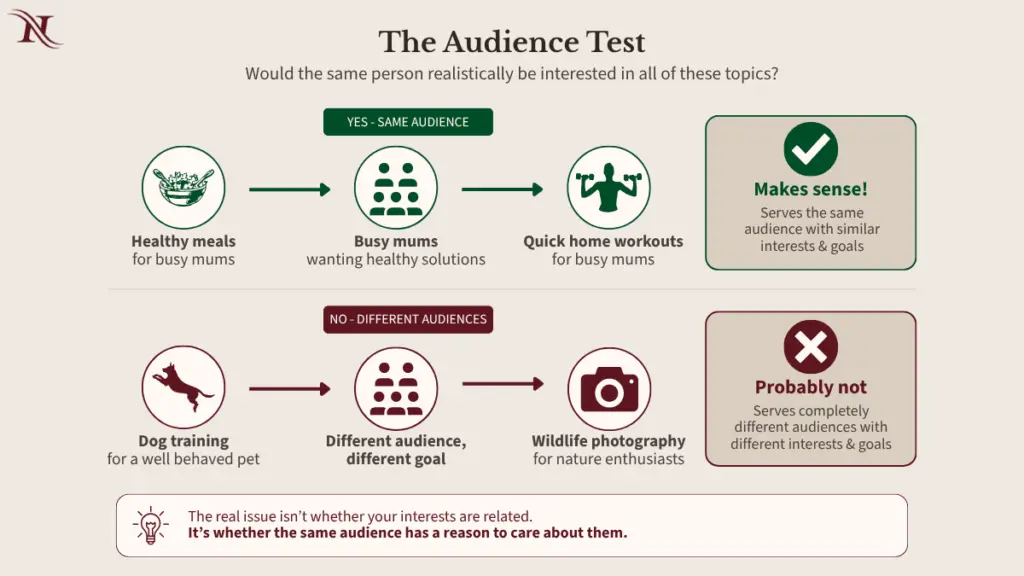
Ultimately, your blog should have a clear purpose for its intended audience. This also aligns with Google’s emphasis on creating helpful, people-first content for an intended audience rather than creating content primarily to attract search traffic.
What If Your Interests Don’t Naturally Fit Together?
This is where things get a little easier once you’ve stopped trying to force everything into one website. You may discover that you have three groups of interests:
Group 1: Fitness, running and healthy cooking
Group 2: Gardening and DIY
Group 3: Photography and travel
And that’s okay. You don’t need to create one enormous blog covering all three. Instead, you can decide which group excites you most and focus your first blog there. And don’t worry, your other ideas aren’t wasted. You can:
- save them for future content ideas
- keep them as personal hobbies
- explore them later
- develop a second site someday
- simply enjoy them without turning them into content
Remember, not every interest needs to become a business opportunity. Sometimes the best thing you can do with an interest is keep it for yourself.
Which Interest Should You Choose?
If your interests don’t naturally combine, you eventually need to choose which one gets your attention first. This is where many aspiring bloggers get stuck because they start trying to find the objectively “best” option.
Instead, start by looking at your relationship with each topic. Give each of your strongest interests a score from 1–5 for the following questions:
|
Question |
Score |
|---|---|
|
How much do I genuinely enjoy this topic? |
/5 |
|
Could I happily create content about it for years? |
/5 |
|
Do I already have useful knowledge or experience to share? |
/5 |
|
Would I enjoy learning more about it? |
/5 |
|
Can I imagine helping a specific type of reader with it? |
/5 |
This isn’t a niche-validation test, and it isn’t designed to tell you which topic is objectively the most profitable or easiest to rank for. It’s simply a way of stepping back and asking:
Which of my interests am I most naturally drawn towards building something around?
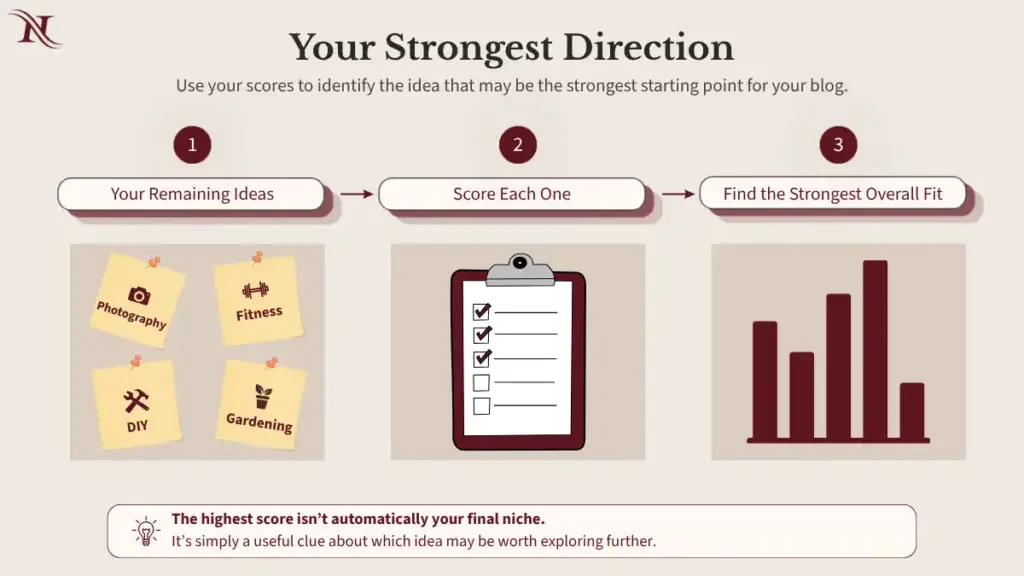
You may find that one topic stands out immediately or you may find that two are very close. That’s useful information too.
Pay Attention to the Interest You Keep Coming Back To
Even after the last exercise, your highest-scoring interest isn’t necessarily the one you should choose. Sometimes the answer is hiding in your own behaviour. Think about the things you naturally do when nobody is telling you to do them. What do you:
- find yourself researching for fun?
- talk about enthusiastically?
- enjoy explaining to other people?
- constantly want to learn more about?
- notice yourself returning to even after months or years?
There’s a difference between being interested in something and having an interest that naturally pulls you back again and again. That second type can be particularly valuable when you’re building a blog because blogging involves creating a lot of content over time.
You don’t need to be obsessed with your niche. But it helps enormously if you can imagine yourself still being curious about it long after the initial excitement of starting your blog has worn off.
What If You Still Can’t Choose?
Sometimes, even after you’ve worked through your interests, you’re still stuck between two or three possibilities. If that’s you, don’t assume you need to keep researching until you discover a magical answer.
You could simply choose the option that feels most exciting and sustainable right now and start there. Remember, choosing a niche isn’t the same as signing a lifetime contract. As you create content, you’ll learn more about:
- what you enjoy writing about
- what your readers respond to
- which topics you naturally gravitate towards
- which areas you want to explore further
Your blog can become more focused as you gain experience. The important thing is to make a reasonable decision and move forward rather than spending months trying to eliminate every possible uncertainty and never actually starting your blog.
How to Tell If Your Blog Has Too Many Topics
There’s a difference between having a blog with several related content areas and having a blog that tries to cover absolutely everything you’re interested in.
There are, however, a few warning signs that can help you spot the difference. Your blog may be trying to cover too much if:
- You can’t describe what the blog is about in a simple sentence.
- Your categories have almost nothing to do with one another.
- Someone interested in one topic has little reason to read your other articles.
- Your homepage looks more like a collection of unrelated interests than one cohesive publication.
- You’re continually adding new subjects simply because you happen to enjoy them.
Having multiple categories isn’t automatically a problem. The real issue is whether the same audience has a reason to care about them.
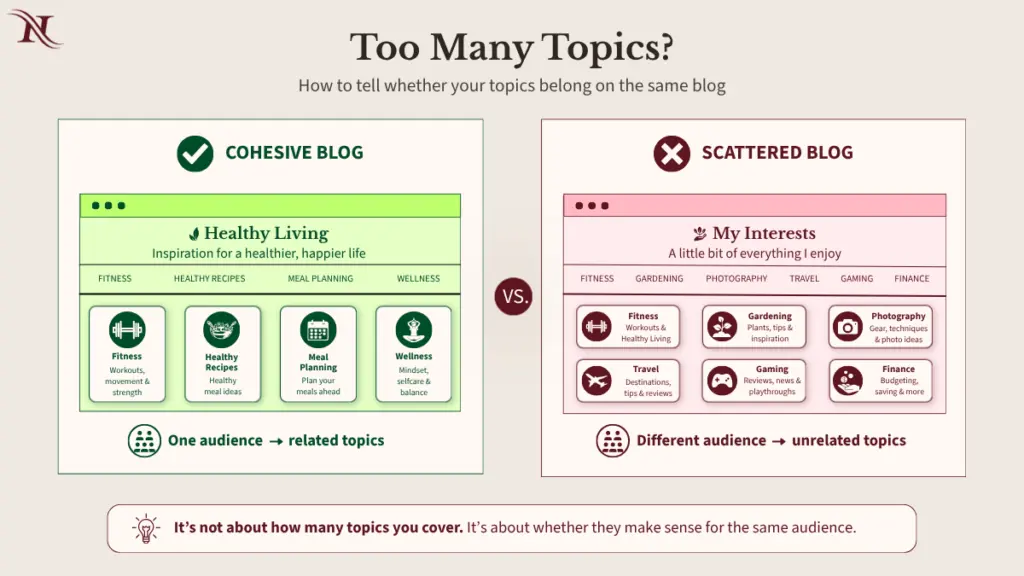
A blog about healthy living could comfortably cover fitness, nutrition and meal planning. A blog about “things I’m interested in” could contain fitness, gardening, gaming, photography, finance and travel, but it would be much harder for a reader to understand what they’re going to get from the site.
A Simple Exercise to Turn Your Interests Into a Blog Idea
If you’re still staring at a long list of interests, try this exercise.
Step 1: List your interests
Write down everything you’re genuinely considering. Don’t edit the list yet.
Step 2: Group related interests
Look for topics that share an audience, lifestyle, problem or goal.
Step 3: Identify the common thread
Ask what connects the interests in each group.
Step 4: Separate the outliers
If an interest doesn’t naturally fit with any group, don’t force it in. Set it aside.
Step 5: Write a one-sentence blog concept
Try describing your strongest idea in one sentence. For example:
A blog helping busy women stay fit and eat well without spending hours in the kitchen.
Or:
A practical gardening blog for beginners growing food in small spaces.
If writing the sentence makes your idea feel clearer, rather than more restrictive, you’re probably heading in the right direction.
Final Thoughts: You Don’t Have to Blog About Everything You Love
Having too many interests is actually a pretty good problem to have. It means you’ve already got plenty of subjects you’re curious about and potentially plenty of ideas to explore. The challenge is simply deciding which of those interests can form a coherent blog.
You don’t have to choose the one topic you’ll write about for the rest of your life. And you don’t have to squeeze every interest you have into the same website.
Instead, look for the connections between your interests, consider whether they serve the same audience, and identify the topic, or combination of topics, you’re genuinely excited to build around.
And if two interests simply don’t belong together, that’s okay too. Choosing one doesn’t mean giving up the others.
Ready to test your niche idea?
Once you’ve narrowed down your possibilities, the next step is to put your strongest idea to the test. Head over to my guide on how to choose a blog niche for a simple three-step process to help you decide whether it’s a strong option for your new blog.
Happy Blog Building!

Helpful Guides to Read Next
These beginner-friendly guides will help you keep building your blog step by step.

Jessie
Founder, nomorerush.com
Hi, I’m Jessie — founder of No More Rush. I help beginners build profitable, beginner-friendly blogs without the overwhelm or unrealistic expectations you see online. Everything here is built around simple, structured steps so you always know what to do next.